Friday, October 27, 2006

Happy Space Elevator Day!

Today is happy Space Elevator day. Why is that? That is because LiftPort, a space elevator company plans on launching the first "lifter shuttle" in orbit on October of this day in 2031.


LiftPort is one of the few (and possibly only) company out there striving to make space available to all (and not just the wealthy and healthy) and if you would like to help make this dream a reality, you can support them by either purchasing their book, enlisting as a LiftPort Ambassador or simply Google-bombing the word "space elevator" with LiftPort's homepage as you can see from the example below:


Although only one score and four years away, wouldn't it be nice to ride in a space elevator? (if not you, at least your kids could go up).

Note: Did we mention listening to music on the way up? (Hat Tip: Space Elevator Blog)

Tuesday, October 24, 2006

Travel To Mars Via Asteroid?

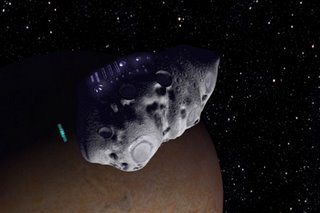
Since traveling to Mars can be dangerous to your health (thanks to cosmic radiation) some researchers are proposing that future astronauts travel to the red planet via asteroids that orbit between Earth and Mars.

(New Scientist Space) In one version of the idea, the astronauts would actually dig a hole in the asteroid, put the spacecraft inside and cover it over with material from the asteroid. Within this protective burrow, the spacecraft would be shielded from cosmic rays during the six- to 10- month journey to Mars.

In a second version, the spacecraft would not contact the space rock. Instead, it would hover nearby, and astronauts or robots would visit it on spacewalks. "You'd have the astronaut actually go to the asteroid and begin to extract material," Della-Giustina told New Scientist.


Hitch hiking via asteroids is pretty ingenious, although it may not work in the long term. If a martian colony is established and an emergency arises, we can not simply depend upon asteroids to bring us to safety across space.

What NASA needs to seriously consider is either investing in creating a radiation shield for the astronauts, or finding out faster ways to travel between worlds (via nuclear or momentum from a space elevator). Although radiation shielding is expensive, it would enable us to travel without fear of having our minds reduced to nothing upon arrival on Mars.

Hubble Trouble, Will Saving It Cost Double?

(Hat Tip: The Astronomy Blog)

Hubble has provided a unique perspective about the universe that no other space program has matched. Its beautiful pictures have probably kept the space program in public view, and helped launch the imaginations of thousands of others.

But keeping Hubble alive is costing NASA (or rather the American tax payer) $230-250 million a year, money that could be spent elsewhere (as in getting humans back on the moon). Despite the cost, NASA seems to have some emotional attachment to Hubble, although it may require two shuttles in order to secure approval for repairing our galactic eye in the sky.

(MSNBC) The remaining 14 shuttle flights are dedicated to completing the space station by the time the fleet is grounded in 2010. If a Hubble servicing mission is approved, it would have to be squeezed into the space station construction schedule sometime in early 2008.

NASA also would have another shuttle on the launch pad, ready to make an emergency rescue trip if there were a catastrophic problem.


The repair trip would only extend Hubble's life by about five years, which would mean that unless another shuttle or rocket was designed to replace it, there would be no easy way to repair Hubble unless the Russians were solicited.

Hubble has made the universe a lot more beautiful by revealing the hidden mysteries that surround us, but if it does not further humanity off world, what is the point in funding future repair missions?

Life On Mars, Is It Possible?

Scientists seem to be excited about discovering bacteria living two miles beneath the Earth's crust, able to adapt to not only extreme cold but also an oxygen-less environment.

(Mars Today) "The low temperature limit for life is particularly important since, in both the solar system and the Milky Way Galaxy, cold environments are much more common than hot environments," said Neill Reid, an astronomer at the Space Telescope Science Institute and leader of the research team. "Our results show that the lowest temperatures at which these organisms can thrive fall within the temperature range experienced on present-day Mars, and could permit survival and growth, particularly beneath Mars's surface. This could expand the realm of the habitable zone, the area in which life could exist, to colder Mars-like planets."


Although it would be interesting to find life on Mars, the planet is not known to be friendly to life as its surface may be toxic, not to mention the lack of a magnetic field.

These organisms may provide another use however, as scientists may be able to insert their DNA into grains and plants, allowing colonists to grow food on the red planet. Of all the worlds that orbit the solar system, Mars provides the greatest opportunity for terraforming. Perhaps these microbes could provide a little assistance along the way.

Monday, October 23, 2006

Space Elevator Games (Enlightening) Revelations

Ted Semon on the Space Elevator Blog and Dr. Edwards over on the Space Elevator Reference have done such a great round up about the X-Prize Cup that there is little need for any extra analysis.

However, after viewing video and reading opinions of bloggers at the event one thing became clear--space may be for the upcoming generation.

Although NASA will undoubtedly build bigger and better (yet more expensive) rockets, the final frontier will still be limited towards the healthy and wealthy, or federal space employees.

It may be a good thirty to forty years until humans begin to travel up a space elevator (an optimistic view, at least from one LiftPort staff member) but perhaps space is not for our generation.

Our fathers may have not prepared us for the final frontier (as their fathers did not do as great a job in this regard) but perhaps the current generation can prepare the future one for the opportunity.

After all, the human race still has plenty of problems to work out on planet Earth (like loving thy neighbor) and perhaps this will give our species time to find a solution for some of these problems before we head off towards the stars.

Wednesday, October 18, 2006

Titan Has Active Volcano's?

It looks like Titan may be able to join the "active terrestrial club" as their are some interesting clues revealing that its surface may harbor some volcanic action.

(New Scientist Space) The brightest spot on Saturn's moon Titan has been seen brightening and growing, suggesting it might be an active volcano, a controversial analysis of images from the Cassini spacecraft suggests. If so, it would be the first indication of current volcanic activity on the giant moon.

Scientists are interested in whether Titan is volcanically active because volcanoes could help supply the large amount of methane seen in its atmosphere. The methane is quickly broken down by sunlight, so it must be getting replenished in some way.


Although not 100% sure, scientist do think that this bright spot may be a volcanic eruption, although instead of magma or water ice (like Enceladus) it may be more of an ethane-methane mixture.

If so, this is good news as Titan lacks the oceans of methane that were once presumed to cover its surface.

Friday, October 13, 2006

Is Asteroid Farming On Ceres Neccessary?


One can not discuss colonizing the solar system without mentioning asteroid mining. Harvesting the asteroid belt for minerals and metals will be critical towards the future space economy as some worlds (such as Mars and Jupiter's Galilean moons) lack the resources necessary to attract businesses and ultimately future colonists.

But in order to establish mining operations millions of miles away from habitable worlds, we need to find a way to feed those who will be doing the "dirty work" of mining these rocks that dance around our sun.

Although shipping food from Earth and Mars may be tolerable, it may impractical (not to mention expensive). Instead of shipping food, water and other items towards the asteroid belt, why not establish farming communities on Ceres instead?
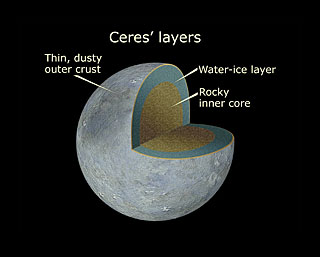
Despite lacking known metallic resources that would make it attractive towards future space corporations, Ceres does have one element that would make this asteroid worth its weight in gold--water. Scientists believe that Ceres could contain up to 200 million cubic kilometers of fresh water--about five times as much as planet Earth.

By having access to a vast amount of liquid wealth, Ceres could easily grow the necessary food for future mining colonies, saving them both time and money as opposed to receiving rations from Earth.

Supplying future asteroid colonies with the necessary food will be difficult, if not nearly impossible as there are thousands (if not millions) of asteroids, each with its own chaotic orbit around the Sun. Without an orbital "ran de vue" point, permanent mining colonies may become "over looked," resulting in outposts being abandoned simply because a space settlement ran out of food.
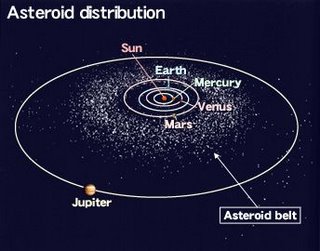
With the heart of the asteroid belt located around 2.7 AU (astronomical unit), Ceres lies in perfect position to supply future colonists with the necessary food supplies, as its orbit ranges between 2.55 and 2.98 AU. As the asteroid king makes its journey around the sun, mining colonies could be easily resupplied with food grown on the rocky world, enabling permanent outposts to focus on extracting minerals and precious metals.

Containing roughly 25% of the asteroid belts mass, Ceres may have the necessary gravity to allow for more plant life than would be possible in a micro gravity environment.

Although hovering around 3% (when compared to Earths), the gravity on Ceres may be tolerable to plant life, although humans may have to adjust to the low gravity by either finding chemicals to counter act atrophy or simply constructing artificial gravity space stations nearby.

Despite being recognized as a dwarf planet, Ceres will play a major role in mining operations within the asteroid belt, if not the solar system as a whole.

By simply acting as an agricultural world (or rather dwarf planet) it will save future Earth and (hopefully) Martian governments millions (if not billions) in transport costs, and may enable humanity to reap the rewards of harvesting the asteroid belt to the benefit of the human race.