Saturday, August 05, 2006

Japan Aiming For Moon Base By 2030

Despite having a zero track record in sending humans into space, the samurai nation is aiming at constructing a lunar base on the Moon by 2030.

(New Scientist Space) Japan's space agency has set a goal of constructing a crewed lunar base by 2030, an official said on Wednesday.

The Japan Aerospace Exploration Agency (JAXA) revealed its ambition to an international conference in Tokyo this week but has not yet been allotted the budget for the ambitious project. [...]

"The feasibility of the plan is unclear at this point as we need to gain understanding by the government and the Japanese people on our plan, but technologically it would be possible in a few decades," said Satoki Kurokawa, spokesman for JAXA.


Despite being known as a tech savvy country, I am not sure if the nation of Japan is serious about space travel. Their Chinese "neighbor" has already begun space farming via satellites and is already planning to build a space station next year.

Japan better start thinking of ways to promote a space culture before the red dragon leaves them behind as a second rate space power.

Saturday, July 29, 2006

Future Spacesuit, Heal Thyself!

This technology would not only benefit astronauts in space, but also future colonists on Mars and the Moon.

(New Scientist Tech) Future spacesuits could have some remarkable new abilities. They could self-repair holes, generate electricity and kill germs, thanks to new "smart" materials. Such suits may be ready for use by 2018, when NASA hopes to return to the Moon. [...]

The spacesuit would be self-healing because its innermost layer, which provides the spacesuit's airtight seal, is filled with a thick polymer gel. The rubber-like gel is sandwiched between two thin layers of polyurethane so that if a hole forms in these layers, the gel oozes from surrounding areas to plug it. In vacuum chamber tests, the gel healed punctures up to 2 millimetres wide.


Developed by ILC Dover LP (from Delaware) for NASA, these future spacesuits may prove quite useful, especially when one considers the hazards of space junk that orbits our world. I could also see this technology utilized for future colonists on the Moon, (for obvious reasons) not to mention future minors in the asteroid belt.

New Ion Cannon Could Bring Us To Saturn

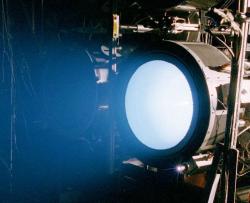
A new ion cannon built by Aerojet (an aerospace company located in Sacramento, California) may provide future space craft with the power necessary to bring them all the way to Saturn's moon, Titan.

(New Scientist Space) An ion engine several times more powerful than any previously flown is being tested by NASA. It could propel a spacecraft all the way to Saturn's moon Titan.

Ion engines operate by removing electrons from atoms of a gas--usually xenon--and then accelerating the resulting ions through an electric field. The ions are shot out the back of the engine to create thrust.

The engines provide much less thrust at any given time than do rockets. But they are much more fuel efficient, providing a steady source of propulsion that could ideally be used to take spacecraft to the outer solar system.


This technology will be quite useful for satellite's traveling in deep space as well as future explorers traveling throughout the asteroid belt. Despite being fuel efficient, we may need something a little faster for colonists as traveling through space can become quite dangerous.

Is Outer Space Sex Really That Complicated?

If this is true, then future space colonists may be in for a major disappointment.

(MSNBC) Having sex in the weightlessness of outer space is the stuff of urban legends and romantic fantasy--but experts say that there would be definite downsides as well.

Spacesickness, for instance. And the difficulty of choreographing intimacy. And the potential for sweat and other bodily fluids to, um, get in the way. [...]

"Sex in space is not just a good idea, it's survival," said Vanna Bonta, a writer who blends romance with space travel and quantum physics in the novel "Flight."


The article later on goes to list several reasons why this event may be "underwhelming," and the list does not look pretty. Vanna Bonta has designed a "2suit" to deal with the problems of weightlessness while...um...you know, but I am going to wager that honey mooners may opt for their birthday suit instead.

China Farming In Space?

Apparently the red dragon nation is preparing to launch another satellite which will conduct experiments on breeding plants in outer space.

(Earth Times) BEIJING: China is expected to launch its first satellite for breeding plant seeds in September. The satellite will be launched from the Jiuquan satellite launch center, according to officials of the Commission of Science, Technology and Industry for National Defense. It will make a 15-day space flight.

The satellite, named Shijian-8, would carry over 2,000 varieties of plant seeds in nine categories and 180 groups, including seeds of grains, cash crops and plants, as well as seeds of fungi and molecular biomaterials that have been sequenced.


Before anyone claims that "natural food" is the way to go, they should examine the results with China's tampering. By exposing these seeds to radiation, China has been able to grow not only more food, but healthier grain as well, making it easier to feed their growing population.

(Earth Times) According to scientists, when seeds are exposed to special environment and subjected to phenomena like cosmic radiation and micro-gravity, they are likely to mutate and offer higher yields and better quality. [...]

China has already established space seed breeding centres in regions such as Beijing, Shanghai and Heilongjiang province. A government official said between 2001 and 2004, space-bred rice and wheat varieties had been planted in about 566,600 hectares of land, producing an additional 340,000 tons of grain.

Experiments show that vitamin content of vegetables grown from space seeds is 281.5 per cent more than in ordinary vegetables and microelements of ferrum, zinc and carotene are also higher than normal.


According to the article, China has done this several times, and it apparently is paying off by producing higher yields of crop. If more experiments like these are successful, it may be wise for future colonies with barren (or no) soil to simply grow their food in orbit rather than on the surface.

Saturn's Titan May Have Methane Lakes

Although I am probably late in the game reporting this, apparently Saturn's cloudy moon may harbor hydrocarbon lakes, making the moon prime real estate for colonization.

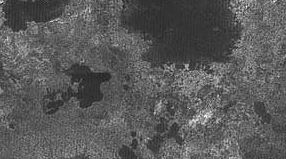
(Saturn Today) The Cassini spacecraft, using its radar system, has discovered very strong evidence for hydrocarbon lakes on Titan. Dark patches, which resemble terrestrial lakes, seem to be sprinkled all over the high latitudes surrounding Titan's north pole. [...]

Scientists have speculated that liquid methane or ethane might form lakes on Titan, particularly near the somewhat colder polar regions. In the images, a variety of dark patches, some with channels leading in or out of them, appear.


This is good news since it was assumed that Titan lacked methane lakes due to previous snap shots of the world. These lakes are located near the polar regions, although "rain drops" from Titan's atmosphere will hopefully create more of them.

Sunday, July 23, 2006

Life Support System For Mars, Moon

We still have a long way to go before we can establish colonies on Mars and the Moon. Despite our lack of knowledge on how the ecosystem on Earth operates (especially within a closed system) some scientists busy finding ways to eliminate those mysteries in order to keep us on our lunar neighbor as well as the red planet.

(Red Orbit) BEIJING (Xinhua) -- Scientists are doing ground-based experiments on life support systems so that humans can explore space and one day live outside the Earth's biosphere, for example on Mars or on the Moon. [...]

Nelson said that researchers have termed the project "Mars on Earth". They stress that substantial work needs to be carried out on Mars life support prototypes here on Earth before scientists will have the data base, confidence and ability to undertake similar projects in space or in lunar/Martian conditions.

The U.S. laboratory being used for the experiment, which covers an area of approximately 800 square meters, is located in Santa Fe, New Mexico. Scientists there are developing life support systems for space, such as water and waste water recycling, food production and air purification, and are also developing space engineering and technology for the Mars Base, Nelson said.


Scientists are trying to find ways to live in a closed system by recycling their waste products and living on a complete diet of plant food (as it looks like meat is off the menu for future colonists). This diet includes ten crops which include "rice, wheat, sweet potato, peanut, soybean, pinto bean, winter squash, beetroot, banana and papaya."

Although the experiment was not a total success (as they ran into some problems) their attempts and failures here on Earth will help us avoid serious problems while setting up habitations on the Moon and Mars.