Monday, February 27, 2006

Noah's Ark On The Moon?

With the discovery of certain resources on the moon, humanity is on the verge of escaping its earthen cradle and settling on its lunar neighbor. But should our species build a "genetic black box" in order to preserve life on Earth against uncertain catastophes?

(Astrobiology Magazine) if we have a laboratory where we can maintain a DNA bank and a pool of species, creating a modern Noah's Ark, then we can potentially recover from such catastrophes.

I think the moon could be used as such a repository in case there is ever a global disaster on Earth. As a lifeboat, the moon is a lot closer than Mars. Plus, we don't know yet if there is life on Mars, and we have to figure that out before we do any life experiments there.


Establishing a DNA Bank on the lunar surface is a noble idea, but unless one can turn those DNA extracts into organism's, it is a useless one.

The essence of life is still beyond our scientific knowledge, and in order for a DNA Bank to be successful, live animals would have to be shipped to the lunar surface.

(Astrobiology Magazine) We would need to have more than just a DNA bank on the moon, because we have learned from biology that life is more than the expression of information coded in DNA. We need to have some living organisms to really express the full range of life. So our lunar lifeboat would need to have a facility to grow plants and microorganisms, and, for more advanced life forms, to incubate eggs and develop embryos.


Establishing a biosphere to house animals on the lunar surface is a noble idea, but one that may ultimately fail. Unlike its more lively neighbor, the moon lacks a magnetic field, a critical element needed to shield against the suns radiation.

If one could be built and maintained it may be a deciding factor between lunar survival and the extinction of a future colony.

Friday, February 24, 2006

Can Faith And Science Mix?

Apparently a reader of Answers in Genesis thought that wasn't the case and wrote a letter to AiG about their displeasure of them "blurring the line."

(Letter sent to AiG) Science can neither prove, nor disprove the ultimate quest of faith: a personal relationship and understanding of god. After all, the ultimate expression of faith is that it exists in the absence of proof, scientific or otherwise.


Although faith may seem like "blind devotion" to those outside of it, only a foolish individual would trust the sayings of any text, prophet, etc. without some form of evidence.

Other religions may or may not demand unconditional questioning of its tenets, but this is not the case for biblical Christianity, Judaism, etc. The being described in these pages was constantly trying to prove himself to those he loved, which often produced faith which is based on evidence.

The rest of the article provides some great points for all those interested in the realms of science and religion.

Monday, February 20, 2006

Space Doctor, Anyone?

Despite the fact that science fiction shows usually cast space doctors as a main character, it is ironic that we are only now seriously considering "casting a role" for one within our solar travels.

(Universe Today) If humans are going to be spending longer periods in space, on the Moon, or even on Mars, it's just a matter of time before they'll need surgery. Can delicate surgery even be done in the weightlessness? [...]

Professor Adam Dubrowksi of surgery doesn't see why not, and he's making space surgery a focus of his research.

There'll be a need for it once astronauts in the International Space Station begin to stay on board for extended periods, says Dubrowski, who is also a kinesiologist in the Surgical Skills Centre at Mount Sinai Hospital.


Although astronauts are given some medical training (several hours at best), a skilled physician will be a "necessary good" onboard, especially for deep space missions towards the Moon or even Mars.

The Canadian Space Agency is already planning to develop a "surgery training protocol" for future astronaut doctors, in order to make sure that they are prepared for operating within a microgravity environment.

(Universe Today) Space-surgery training will be three-pronged, Dubrowski explains. The first step is adaptation to zero gravity using an inverted paradigm in which experimental participants are placed upside down on something similar to a bed to "get more of an idea of weightlessness."

The second step will be simulating zero gravity in a swimming pool [...]

Third, trainees will take their basic surgery skills on parabolic flights in which an airplane ascends and descends roughly 40 times, creating a transient zero-gravity environment on the descents.


These tests will probably be expanded once humanity establishes a strong presence on the Moon. Although medical personnel may become a common scene aboard the space station and elsewhere, hopefully they will be as exciting as the doctors seen on Star Trek or Babylon 5.

Volcano Telescope?

It looks as if the United States and its southern neighbor Mexico are about to partner in order to build a massive telescope ontop of a volcano. Although Mexico is grateful for the financial partnership, they do not appreciate the source of funding.

(Red Orbit) [T]he fact that most of the U.S. funding comes from the Defense Department has worried some Mexicans who are leery of any military connections with their powerful northern neighbor.

"We want Mexico to be in the vanguard of scientific advance, but it would be better if all the money came from non-military sources," said Rosa Maria Aviles, a federal lawmaker on the lower house of Congress' Science and Technology Committee. "We are a pacifist nation."


The Pentagon often funds scientific projects in order to reap the benefits that these endeavors produce. The telescope will cost an estimated $120 million and be constructed 15,000 feet ontop of the Sierra Negra within the central state of Puebla.

(Red Orbit) "We will get incredible new insight into how galaxies were first formed," said project scientist David Hughes of Mexico's National Astrophysics Optics and Electronics Institute. "Once we start operating, we should be making breakthrough discoveries on an almost daily basis."

Scientists also will be able to collect new data on nearer galaxies such as Andromeda and examine all its stars and planets to see what may lurk there.


Hopefully this telescope can be used to not only view the stars that orbit other galaxies, but also be able to locate possible worlds for colonization for the human race.

Note: Ironically, building this telescope at such an height has caused some "issues," as villagers employed by the government had trouble bringing up the needed materials in their vehicles to construct the project. They reportably had to switch to using mules, an animal bred for that altitude.

A Small Climb For Man (Space Elevator)

Who ever said that building an elevator to the stars was impossible? It seems that one company is envisioning just that--and putting those plans into practice.

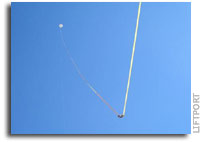
(Spaceref.com) LiftPort Group, the space elevator companies, today announced that it has successfully completed its second round of preliminary tests of its high altitude platform and robotic lifters. [...]

In this phase of testing, conducted earlier this month in Arizona, LiftPort successfully launched an observation and communication platform a full mile in the air and maintained it in a stationery position for more than six hours while robotic lifters climbed up and down a ribbon attached to the platform.


The robots were able to climb more than 1500 feet, surpassing the previous record of 500 feet. A space elevator is not only feasible, but also less costly than sending a rocket into orbit. Constructing a space elevator will not be easy, as one can tell by how high Lift Port intends to build the structure.

(Spaceref.com) A revolutionary way to send cargo into space, the LiftPort Space Elevator will consist of a carbon nanotube composite ribbon eventually stretching some 62,000 miles from earth to space.

The LiftPort Space Elevator will be anchored to an offshore sea platform near the equator in the Pacific Ocean, and to a small man-made counterweight in space.

Mechanical lifters are expected to move up and down the ribbon, carrying such items as people, satellites and solar power systems into space.


Although many nations may prefer to send their cargo, astronauts, etc. via rocket ship, such a procedure may be too costly for their national budget. A space elevator will probably be inexpensive and enable less developed nations to launch satellites into orbit as their is no cost for rocket fuel.

Constructing an item such as this will take enormous effort, but if successful, Lift Port may be the first modern company to build the eighth wonder of the world.

Monday, February 13, 2006

Teaching Both Sides Of Evolution In Ohio

According to a poll by Zogby International, residents of Ohio favor teaching the weaknesses and strengths of evolution.

(Evolution News) "Ohioans want Darwin's theory of evolution fully and completely presented, including the theory's strengths and weaknesses," said Robert Crowther, director of communications for Discovery Institute, which commissioned the Zogby poll. [...]

Sixty-eight percent of respondents said they agreed with the following statement: Biology teachers should teach Darwin's theory of evolution, but also the scientific evidence against it. Less than 20 percent supported the alternative statement: Biology teachers should teach only Darwin's theory of evolution and the scientific evidence that supports it.


This is encouraging as it would allow students to understand the debate around our origins more clearly and perhaps validate why some have left Darwins faith in the first place. It also seems that the populace are willing to go a step further, one where the politicians do not--teaching Intelligent design in the classroom.

(Evolution News) "Surprisingly, Ohioans want to go further than their leaders with 75% favoring teaching intelligent design alongside of Darwinian evolution," added Crowther. "Even after all the attacks on intelligent design by the dogmatic Darwin-only lobby, the public clearly wants to know more about the theory and make up their own minds."


Although Intelligent Design has yet to prove itself as scientific it may open the doors to other theories bashed by some in the scientific community (such as Creationism). Just as one discusses politics before choosing a party so one must discuss the theories of origins before choosing a system.

Only by analyzing the strengths and weaknesses of the evolution theory (of which the latter there are many) can we enable people to decide for themselves and thus hopefully end the debate.

A Future Retrograde Solar System?

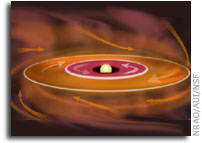
A new star system in infancy may give birth to planetary systems orbiting in the opposite directions. According to present theories, worlds usually orbit stars in the same direction, although this new find may shatter former perceptions.

(Spaceref.com) "This is the first time anyone has seen anything like this, and it means that the process of forming planets from such disks is more complex than we previously expected," said Anthony Remijan, of the National Radio Astronomy Observatory, who with his colleague Jan M. Hollis, of the NASA Goddard Space Flight Center, used the National Science Foundation's Very Large Array radio telescope to make the discovery.

"The solar system that likely will be formed around this star will include planets orbiting in different directions, unlike our own solar system in which all the planets orbit the Sun in the same direction," Hollis explained.


This star is located about 500 light years away from Earth and is located in the direction of the Ophiuchus constellation. Star systems normally acquire "planet building material" which is generally taken from a prestellar cloud. Apparently this young system has somehow captured two.

(Spaceref.com) "We think this system may have gotten material from two clouds instead of one, and the two were rotating in opposite directions," Remijan said.

There is sufficient material to form planets from both parts of the disk, he added. The object is in a large, star-forming region where chaotic motions and eddies in the gas and dust result in smaller cloudlets that can rotate in different directions.

In the solar system that probably will form around this young star, the innermost planets will orbit in one direction and the outer planets will orbit in the opposite direction.


Sightings like these generally occur within the disks of galaxies, although this is the first time something like this has been observed an emerging system. If we are ever fortunate enough to visit this system (after the worlds cool) it will make an interesting place to call home.