Thursday, May 25, 2006

Using Earthshine To Discover Alien Life

Although this technique is controversial (as in whether it works or not) some scientists think that they can use "Earthshine," or sunlight reflecting off of our homeworld to detect life on other planets.

(New Scientist Space) Earthshine--the dim glow from sunlight bouncing off the Earth, and reflected back from the Moon's surface--may aid in the search for life on other planets, say scientists. [...]

[Wesley Traub of NASA's Jet Propulsion Laboratory] and other researchers detailed how the spectrum of Earthshine reveals the presence of ozone and chlorophyll, both sure signs of biological activity on Earth. In the future, it is expected that planet hunting space telescopes will be able to resolve Earth-like planets as tiny pinpricks of light circling around their parent stars.

And though such a "pale blue dot" would not likely reveal any visual details, its spectrum might be enough to distinguish between a sterile and a living world.


This idea is probably worth exploring. Although worlds such as Mercury and Mars (if it has resources) may prove themselves to be worthwhile over time, colonizing more habitable planets would be in our long term best interests. Not only would it cost less money, but would require less energy to colonize as well.

Update: Added photo and corrected html.

Possible Setback For Space Elevator

(Hat Tip: Space Elevator Blog)

Apparently a scientists has noticed a critical setback for building a space elevator. The problems lies not in the overall layout of the space elevator, but rather its nanotube building blocks.

(Nature) Is it possible to make a cable for a space elevator out of carbon nanotubes? Not anytime soon, if ever, says Nicola Pugno of the Polytechnic of Turin, Italy. Pugno's calculations show that inevitable defects in the nanotubes mean that such a cable simply wouldn't be strong enough. [...]

Laboratory tests have shown that individual nanotubes can withstand an average of about 100 GPa, an unusual strength that comes courtesy of their crystalline structure. But if a nanotube is missing just one carbon atom, this can reduce its strength by as much as 30%. And a bulk material made from such tubes is even weaker. Most fibres made from nanotubes have so far had a strength much lower than 1 GPa.


Pugno goes on to state that even if we were able to produce perfect nanotubes, they could (over time) be corroded by oxygen molecules and micrometers from space. When asked whether or not a Space Elevator could be built, Pugno replied, "With the technology available today? Never." There are some however who disagree.

(Nature) [Bradley] Edwards, who is president and founder of the Dallas-based company Carbon Designs, shrugs off the controversy, and says that with adequate funding he could make cables at or above the 62-GPa benchmark in just three years. He suggests that the key step is carefully spinning long nanotubes together in a close-packed way, which encourages cooperative frictional forces that make the strengths of individual nanotubes less crucial.


What many people fail to realize is that the concept of a Space Elevator is still in its infancy. Current technology (including Edwards proposed method) may not be adequate enough to construct an elevator reaching towards the heavens, but we should never rule out future technology to resolve the issue.

Although debate about the possibilities of a Space Elevator are great, we must remember that a construct like this may take decades to build and it would be silly to expect something like this to be finished within a short few years.

The purpose of the Space Elevator is to benefit future generations, not just the near present and if we become impatient because our brains can not rack up a solution tomorrow then we might as well not even try to go back to the moon.

Slamming Ice Into The Moon?

(MSNBC) A strikingly simple concept would provide efficient water provisions for human outposts and even bases on the moon. The idea is to clobber our already crater-rich neighbor repeatedly with tons of water ice — to establish an "anywhere, anytime" delivery system.

Not only could chucking a payload of water ice to the moon help sustain an expeditionary crew there, the impact would mimic--in experimental form — a comet strike. Therefore, it’s a double-whammy: A science mission wrapped within an exploration capability test mission.


The theory behind the idea is to provide astronauts with ice water "whenever, wherever" on the moon. Although some of the ice would be lost on impact, the majority of it would survive on impact. Future astronauts would be able to "mine" water ice from any location within the crater, saving time and energy.

Tuesday, May 23, 2006

Magnetic Sled Hurling Objects Into Space?

With all of the talk of Space Elevators and rocket ships blasting humanity into space, it looks as if someone has found a new way to send objects into orbit--via a magnetic sled.

(New Scientist Space) IT SOUNDS more like a roller coaster than a spacecraft launcher: a levitating sled that whirls around a giant magnetic ring at ever increasing speeds before shooting up into the sky. [...]

LaunchPoint, which is being funded by the US air force, claims a circular accelerator could allow the magnetically levitating sled to progressively build up speed over a period of hours. It would then be launched up a ramp at 10 kilometres per second, firing it into orbit.


Before anyone writes this off as "another silly space idea," they should remember the same thing was probably said of launching satellites into orbit before Sputnik, landing on the moon and (in the future) the Space Elevator. This new method has the potential to seriously reduce the cost of launching satellites (and hopefully space shuttles) into orbit.

(via LaunchPoint's Site) How revolutionary would a Maglev space launch system be? Consider that the first magnetic launch systems are expected to propel payloads into orbit at a cost of roughly $750 / lb, already a significant improvement over the current rocket-launched cost of around $4,000 / lb. Now realize that the total cost to orbit might eventually drop below $100 / lb, and it soon becomes clear how vitally important this technology is to the future of space.


LaunchPoint has already been awarded a $100,000 from the US Department of Defense Small Business Technology Transfer Program, and so far this new piece of technology looks promising. Unfortunately the site does not have a weblog in order for space junkies to keep up with what is happening at the company, but for now email subscriptions will suffice.

Flashy Goggles To Combat Space Sickness?

Space sickness occurs more than the public realizes, affecting at least 60% of astronauts during and after visiting outer space. This often hampers what an astronaut can do during the first few days of flight, which can translate into lost opportunity (and perhaps lost dollars).

A new piece of technology is hoping to change all of that, by targeting an organ few have thought of before--the eyes.

(New Scientist Space) Goggles that simulate a strobe-lighting effect could prevent the nauseating effects of space sickness--and that of more down-to-Earth travel. [...]

[Millard Reschke at JSC] came up with the idea for the glasses after observing a particular astronaut who had returned from a long stay on Russia's former space station, Mir. [...]

Reschke's team noticed that the astronaut's eyes darted back and forth more than normal. The team suspected these eye jitters--known as square wave jerks--were helping to "freeze" the moving visual scene on his retina, protecting him from space sickness.


The "eye wear" resembles 3-D glasses with shutters built in that switch from dark to light extremely fast. This creates a strobe affect and in several tests has successfully proven to prevent space sickness in micro gravity.

More testing needs to be conducted, but if successful, future astronauts may be opting for the goofy glasses rather than taking drugs.

Monday, May 22, 2006

Habitable Exo-Solar Planets Found

Although discoveries of exo-solar worlds are becoming a common phenomenon, its not every day that you hear of a planet orbiting within the "habitable zone," a region of space suitable for Earth like conditions.

(MSNBC) "For the first time, we have discovered a planetary system composed of several Neptune-mass planets," said study team member Christophe Lovis of the Geneva Observatory in Switzerland.

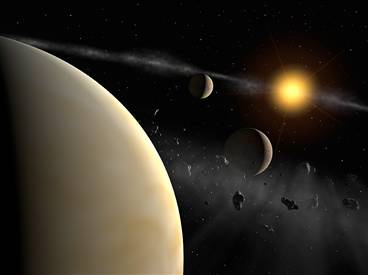
The setup is similar to our own solar system in many ways: The outermost planet is located just within the star's habitable zone, where temperatures are moderate enough for liquid water to form, and the system also contains an asteroid belt.

The newly discovered planets have masses about 10, 12 and 18 times that of Earth, and they zip around the star in rapid orbits of about nine, 32 and 197 days, respectively.


Although the two inner most worlds are probably too close to the sun, the outer one lies within "the habitable zone" making it a prime target for colonization. Despite being a Neptune sized planet, it may have lunar bodies which would make them prime candidates for future colonies.


An artist's conception shows the three Neptune-scale planets thought to circle the sunlike star HD 69830. The outermost planet may have conditions capable of sustaining life, scientists say.


(MSNBC) Recent observations by NASA's Spitzer Space Telescope last year revealed that HD 69830 also hosts an asteroid belt, making it the only other sunlike star known to have one.

When the asteroid belt was found, it was suspected that there might be an unseen planet that was shepherding the asteroids; it now seems that there is more than one shepherd. The researchers think the asteroid belt could lie between the two outermost planets, or beyond the third planet.


This star system is about 41 light years away from our own and lies in the Puppis the Stern constellation. Although we do not have the technology to view asteroids, it would be interesting to figure out their composition (as it would increase the value of this system for future colonists).

Bible Being Taught In Public Schools

This news will probably not make many supporters of "evolution only" advocates happy, but it will open up students towards another perspective.

(Christian Post) The long-dormant idea of teaching public school students about the literary and historic importance of the Bible is getting a fresh look this year from state legislatures and local school boards--though with political bickering and questions about what should be included.

The buzz results mostly from "The Bible and Its Influence," a glossy high school textbook with substantial interfaith and academic endorsements. It's available for the coming school year, and some 800 high schools are currently considering the course.


This curriculum is being published by the Bible Literacy Project of Front Royal, Va. and they are even launching a teachers addition next month. Teaching students about the bible will probably expose children to the debate over evolution and theology (which will benefit all) and help them decide on which world view to embrace.

And if any organizations feel threatened by the new curriculum and threaten legal action, the Washington's Becket Fund for Religious Liberty is supplying lawyers free of charge (although the American Center for Law and Justice probably would help out as well).