Wednesday, December 06, 2006

NASA Regains Its Manhood (Destination: Moon)

(Hat Tip: Space Scan)

After decades of spending billions on projects helping us orbit our own planet, NASA has decided to change course and retake lost ground on our lunar neighbor.

(MSNBC) NASA announced Monday its strategy and rationale for robotic and human exploration of the moon, determining that a lunar outpost is the best approach to achieve a sustained, human presence there. [...]

"What we're looking at are polar locations...both the north pole and south pole," said NASA Deputy Administrator Shana Dale. Picking between the two poles will be done once NASA's Lunar Reconnaissance Orbiter begins surveying the moon after its launch in October 2008.

One particular area that's already receiving high marks by NASA's lunar architecture team is at the South Pole-a spot on the rim of Shackleton Crater that's almost permanently sunlit.


This announcement is long overdue, and despite the complaints of costs by some, NASA should be able to fund this project as well as the various science programs. Although cutting back on these programs is not fun (as that means somebody is out of a job), it would probably be better for this to happen in the short term than having us forever observing the stars.

Monday, December 04, 2006

Artificial Gravity And Orbital Space Stations?


One of the biggest challenges towards colonizing the solar system (and beyond) is gravity--or rather the lack thereof. Gravity plays an important role in the health of the human body, and the lack of it for long periods of time can be dangerous for future space colonists.

Although it is currently unknown at what percentage of Earth gravity is necessary for human survival, we may have to build enormous space stations that can simulate gravity via centripetal force.

(AstroProf's Page) In science fiction, this is an easy problem to solve - you use artificial gravity generators. Actually, I rather think that this is an invention of producers who wanted to keep special effects budgets down rather than any attempt to overcome physiological problems! [...]

For large space colonies, with a very big radius, the colony could be rotated at a comfortably gently rate, people living in the ring at the outer edge of the colony would feel just like they were on Earth (if f = 1). So, this is how we'd more likely generate artificial gravity, rather than with the graviton generators used in science fiction.


Since most of the solar worlds lack the necessary gravity to enable human colonies upon their soils, we may be stuck living in orbital stations except for brief visits to the surface.

Although this may produce an acute form of cabin fever (if the stations are small that is) it is better to ere on the side of caution in this regard than to suffer the side effects of micro-gravity.

Update: Adjusted image for size and credit. Also added extra category for post.

Saturday, December 02, 2006

Helicopter Hover For Future Mars Lander?

It looks like the terrestrial helicopter has inspired one company to design a lander that may aid in future missions to the red planet.

(MSNBC) If NASA's 2009 Mars Science Laboratory reaches the red planet's surface in one piece, the agency will owe a debt of gratitude to the Sikorsky S-64 Skycrane heavy-lift helicopter.

Like its namesake, NASA's Sky Crane carrier platform will hover above its drop site - albeit with retrorockets rather than rotor blades - and lower its payload, the compact car-sized MSL rover, to the surface using a winch and tether. As soon as the rover is ready to roll, the tether connection will be severed and the Sky Crane will fly off and crash land a short distance away.


NASA seems to be favoring this method as the current "balloon bounce" on the Martian world does not give the space agency many options to land (as the landing site has to be free from sharp rocks).

Using the Sky Crane will enable NASA to land the rover or craft virtually anywhere on the Martian surface, allowing them to explore key areas on Mars and hopefully discover some resources to make the trip worth it.

Hopefully sometime in the current century humanity will be able to actually visit the Martian landscape, although we may have to wait sometime after the first space elevator is built in order to make the journey cheap enough.

Russia Considers Lunar, Martian Space Elevators

(Hat Tip: Space Elevator Blog, One and Two)

Not desiring to deal with the hassles of launching and landing a payload from Earth to the Moon and Mars, Russia is considering building a space elevator in order to help cut down on transport expenses.
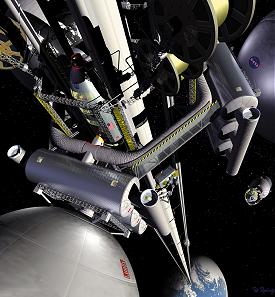
(RIA Novosti) Scientists from the Space Research Institute of the Russian Academy of Sciences have developed a unique space elevator for lunar and Martian missions. Although a bit slower, the new system will cut back on interplanetary delivery expenses. [...]

In 1965, the Central Machine-Building Design Bureau, headed by leading rocket scientist Sergei Korolev, a member of the Soviet Academy of Sciences, started preparing for the first space-tether experiment. The Bureau, which later changed its name to Energia Rocket and Space Corporation, planned to link a Soyuz spacecraft to the last stage of the launch vehicle using a steel cable. Unfortunately, this project was mothballed after Korolev's death and resumed by Energia only 20 years later.


The fact that they started this project is a testimony to the Russian spirit to push the boundries of space technology as we know it. Although there is no mention of a space elevator on Energia's website, it is good to see another company (aside from LiftPort) taking the concept seriously, if not on Earth then elsewhere.

The Russian Space Research Institute, another organization considering the possibilities of a space elevator, has already outlined a fancy way of building one on the Moon.

(RIA Novosti) Theoretical studies and experiments showed that the cluster should comprise two cableway systems, one in a low circular and the other in a low elliptical Earth orbit, and one cableway in a circular equatorial lunar orbit. The dimensions of all three cableways should create different gravitational potentials at each end. By adjusting tether length, it will be possible to change each orbital system's angular speed of rotation.

The space-elevator cluster will exchange payloads between orbital cableways. In essence, two-way freight traffic would turn such cableways into a transportation artery.


A lunar space elevator would definitely go a long ways towards colonizing the lunar surface. There are some who even think one may be built before one is constructed on Earth.

But unlike the moon, a lunar space elevator would have to be constructed out of cheap materials due to the fact that space rocks raining down from above can easily damage the lunar lift, temporarily crippling transport to the moon.

A Martian space elevator may not fare any better, as the red planet is known to harbor violent storms that cover the entire surface.

Russia may be able to overcome both of these problems (at least in the lunar scenario) as one should not wager against technological breakthroughs in the space arena. But even if space elevators are only feasible on planet Earth, just being able to construct one within the solar system is enough to change the history of our planet as we know it.

Space Rocks Could Endanger Future Moon Colonists

As humanity heads back towards the moon, we may have more than just radiation from the sun (or dust from the soil) to deal with. Colonists may also have find a way to cope with space rocks raining down from on high.

(Space.com) Potentially dangerous small space rocks are smashing into the Moon a lot more often than was expected, according to an ongoing NASA study.

"We've now seen 11 and possibly 12 lunar impacts since we started monitoring the Moon one year ago," said Bill Cooke, head of NASA's Meteoroid Environment Office. "That's about four times more hits than our computer models predicted." [...]

"The flashes we saw were caused by Leonid meteoroids 2 to 3 inches (5 to 8 cm) in diameter," Cooke said today in a NASA statement. They hit with energies equal to 150 to 300 pounds of TNT.


Although it may be impossible to shoot down and track such objects entering lunar territory, it may not be improbable to create a strong enough barriers (or force fields) that can sustain damages from such impacts.

If so, then colonizing the Moon would quickly become a reality, allowing us to build communities and use our lunar neighbor as a springboard for Mars.

With Congress Lacking Vision, NASA Keeps The Faith

With Congress more focused on social programs, tax cuts and votes towards the future, NASA is not dismayed by Washington's lack of support for the Centennial Challenge.

(Aviation Week) NASA says it will continue to support its Centennial Challenges prize program, despite the fact that Congress may be on the brink of denying funding to the effort for the second year in a row.

Senate appropriators have voted to deny the program's $10 million fiscal 2007 budget request, although the Senate and House have yet to agree on a final FY '07 NASA budget (DAILY, Nov. 29).

Centennial Challenges is still planning to offer purses for seven prizes totaling $10.9 million, using funds originally appropriated for FY '05, according to NASA spokesman Dave Steitz. "We have spread out the money into the 'out years' to allow for multiple challenges and purses," he told The DAILY.


Although this is a classic example as to why the public can not rely upon government initiatives to bring us to the stars, (as politics can be short sighted at times) this move by NASA to continue financial support shows that their is some hope for the space agency.

If NASA began to actually apply more of this "solar backbone" when it comes to politicians and bureaucrats, the US could seriously implement Buzz Aldrin's road map to Mars within our lifetime.

NASA And UK To Conquer The Lunar Frontier

(Hat Tip: Space Scan)

It looks like the English worlds (both old and new) will be forming an alliance to pioneer the surface of the Moon--and reclaim humanities place among the stars.

(BBC) Britain could become involved in Nasa plans to send astronauts back to the Moon by 2020, science minister Malcolm Wicks has said.

He met Nasa chief Dr Michael Griffin at the Cabinet War Rooms to discuss the plans for future Moon landings. [...]

"We will be considering whether there is an opportunity to build a partnership with the US."


With NASA and England partnering up with each other, it looks as if a new space race is quickly emerging as both China and Russia are already considering partnering up for a lunar trip themselves.

This "East vs. West" space race could prove quite useful, as it would be better for the world to compete for lunar first place than for diplomatic or military supremacy on planet Earth.