Wednesday, November 15, 2006

LiftPort Promo Video: Space Elevator Happiness?

(via Space Elevator Blog)

LiftPort has (to my knowledge) released a teaser video promoting their company on YouTube (which you can see below).


Review: To quote Ted Semon, "For some reason it makes me think of Fantasia."

One almost expects to see dancing hippos lifters gracefully crossing the earthen sky. Although not as good as the Elevator 2010 promo video, its a good start for the LiftPort team.

Tuesday, November 14, 2006

Magnetic Safe Havens On The Lunar Surface

Despite lacking a "global" magnetic field, the moon appears to be broadcasting magnetic currents over certain areas on the surface. This is good news for future space colonists, as that means that certain regions may be free from cosmic radiation, making habitation of the lunar body all the more likely.

(Space.com) Yet amidst this hostile landscape a number of safer havens exist where the lunar surface escapes much of this sleet of radiation. One such benign feature, named Reiner Gamma [image], lies on the Moon's Earth facing side and is marked by a 37-mile-long (60 km) bright swirl and one of the strongest magnetic fields found on the lunar surface. [...]

Not only does the magnetic field preserve an unsullied lunar surface but it would partially protect any astronauts strolling beneath, "The lunar fields are strong enough to deflect solar wind ions with energies of several kilo-electron-volts," [Lon Hood of the University of Arizona] said.


Scientists also think that these fields may enable the concentration of hydrogen via solar wind and helium 3, an element that may rival OPEC on Earth below. If humanity is able to take advantage of these safe havens, we will be able to not only survive the harsh space weather (i.e. radiation) but raise children on the moon as well (since they may have more fragile bodies than adults).

Monday, November 13, 2006

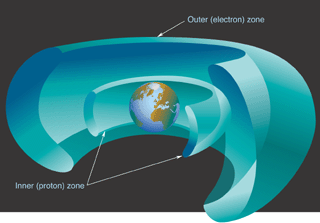
Will Radiation Belts Dampen Space Elevator Hopes?


If a space elevator can be built When the first space elevator is built, humanity will be able to send up cargo at a fraction of the price compared to rockets. Unfortunately, humans may not be able to ride up the cable due to one, minor problem--radiation.

(New Scientist Space) [H]umans might not survive thanks to the whopping dose of ionising radiation they would receive travelling through the core of the Van Allen radiation belts around Earth. These are two concentric rings of charged particles trapped by Earth's magnetic fields.

"They would die on the way through the radiation belts if they were unshielded," says Anders Jorgensen, author of a new study on the subject and a technical staff member at Los Alamos National Laboratory, New Mexico, US.


Several options have been proposed to deal with this, such as moving the base station away from the equator, uploading a magnetic field and last, redesigning the lifter to incorporate shielding (which would make it five times heavier). LiftPort (a space elevator company) seems to be exploring the "heavy lifter" option.

(New Scientist Space) Finally, space elevator builders could simply increase the overall mass of the elevator "car", or lifter - which will require more energy to heave it into space. LiftPort Group, which plans to take up as many as 20 people per trip, will pursue this strategy with a 100-tonne lifter. That is significantly heavier than the 20-tonne lifter planned by Brad Edwards, who devised the current conception of a space elevator.


Making a space elevator that heavy may have dire consequences, which may limit how much cargo a lifter can carry into space (thus reducing profits and increasing costs).

Although I am not an engineer or scientist, perhaps a more novel way at approaching this problem would be simply to create a "safe room" composed of lead where passengers could sleep and interact until the radiation danger is over. It may mean that the lifter is 30 tons instead of 20, but that definitely would be better than 100 tons.

Radiation Protection From A Nano Particle

If humanity is ever going to travel to Mars and live off world, new ways for dealing with the radiation problem (which can fry your brain) have to be dealt with.

Scientists have discovered a nano particle that may help astronauts become resistant towards the side affects of radiation, a minor step enabling our species to live on other worlds.

(Space Daily) Researchers at the Kimmel Cancer Center at Thomas Jefferson University in Philadelphia say the nanoparticle, DF-1, might be part of a "new class of radioprotective agents" that help protect normal tissue from radiation damage just as well as standard drugs.

The scientists have shown DF-1 -- a soccer ball-shaped, hollow, carbon-based structure known as a fullerene -- is as good as two other antioxidant drugs and the FDA-approved drug Amifostine in offering protection from radiation.


Drugs, combined with radiation shielding may enable people to travel across the stars--as well as live on other worlds. Most planets and moons within our solar system lack a magnetic field, exposing them to solar and cosmic radiation.

Drugs like these may prove effective for not only visiting other worlds, but raising children on them as well.

Russia And China Partnering In Lunar Outreach

With the US heading to the moon alone, Russia and China are partnering together in order to increase their chances of actually visiting the lunar world.

(Moon Daily) China and Russia are discussing lunar exploration co-operation in the next three years, the deputy head of the Russian Federal Space Agency said Thursday. Russia regards China as a "partner" in space exploration, Youriy Nosenko told a press conference in Beijing, adding that the two sides have shown interest on a lunar project.


While both have independently visited the stars, neither has the budget to compete against their American friends. Perhaps joining forces is the best measure, as they are already working together in order to reach Mars.

Wednesday, November 08, 2006

NASA Advances In Carbon Nanotube Production

NASA Goddard Space Flight Center (located in Greenbelt, Maryland) is licensing its technique for building high quality, low cost carbon nanotubes.

(SpaceRef.com) Although CNTs were discovered 15 years ago, their use has been limited due to the complex, dangerous, and expensive methods for their production.

However, Goddard researcher Dr. Jeannette Benavides developed a simpler, safer, and much less costly manufacturing process for single-walled CNTs. The key to the innovation developed by Dr. Benavides was the ability to produce bundles of CNTs without using a metal catalyst, dramatically reducing pre- and post-production costs while generating higher yields of better quality product.


Carbon nanotubes have uses beyond a space elevator, ranging from fuel cells, solar cells, video displays, not to mention medical advances as well.

Note: LiftPort's Nanotech department may want to consider purchasing a license, unless of course they already developed a similar method at their New Jersey facility.

Can Science Locate God Amongst The Heavens?

There are some scientists who believe that instead of looking for God among ancient text, that humanity might be better served by seeking him out amongst the stars.

(New Scientist Space) [S]ome physicists believe there is another way to pick up a divine message that will leave traditionalists rolling their eyes to the heavens. Forget scripture, they say, try looking out to space instead.

Impossible? Not necessarily, according to physicists Stephen Hsu and Anthony Zee. No one knows why our universe came into existence. But Hsu and Zee argue that if some superior being or beings did intentionally create it, they might have left an elaborate signature in the cosmic microwave background, the relic radiation of the big bang.


Despite the fact that God could have left a message in the heavens, doing so would seem very illogical, at least to me. After all, wouldn't it be easier for a divine being to simply enlighten men with visions of himself than wait for Earthlings to develop the technology to hear his voice?