Wednesday, November 08, 2006

The Lunar Dust Dilemma

Although not toxic, lunar dust can be quite annoying to human lungs, eyes and even your mechanical bots.

(MSNBC) [Apollo 17's Gene Cernan] said that "one of the most aggravating, restricting facets of lunar surface exploration is the dust and its adherence to everything no matter what kind ... and its restrictive friction-like action to everything it gets on." The astronaut added: "You have to live with it but you're continually fighting the dust problem both outside and inside the spacecraft."


Despite being uncomfortable, some scientists have come up with ways to resolve the dust problem such as melting the lunar soil so it will not irritate future colonists.

Could Riding A Space Elevator Be Dangerous?

If humanity is ever able to construct an elevator to the stars, they may have to overcome a haunting problem that will plague all those who desire to live space.

(New Scientist Space) [P]assengers could be killed by the radiation they receive on the way to the top, say Anders Jorgensen and Steven Patamia at Los Alamos National Laboratory in New Mexico, and Blaise Gassend of the Massachusetts Institute of Technology. At the proposed speed of 200 kilometres per hour, passengers would spend a few days in the Van Allen radiation belts, long enough to induce severe sickness and even death.


The article (which requires subscription) proposes shifting the elevator away from the equator in order to avoid the belts of radiation. Despite being a great idea, such a move would reduce the amount of momentum needed to lift objects into space.

It would probably be wiser to simply launch vehicles until a radiation solution can be discovered as moving the base away from the equator would mean lengthening the space elevator cable.

Friday, November 03, 2006

Short Space Elevator Film

Here is a short film show casing the space elevator via YouTube.


Unlike many films online this video highlights the friction between the tether and the lifter as it climbs its way towards the stars. I wonder if a climber speeding that fast (and causing that much friction) would wear out the tether in a year or two?

One interesting aspect of this short film was the asteroid as a counter weight. Although held up to some as a good idea, no earthly government would be comfortable with a rock that large near earth. Such an idea by itself would be enough to kill off the space elevator idea.

A New Currency For The Space Elevator?

(Hat Tip: LiftPort, and the Space Elevator Reference)

Mondolithic is auctioning off a silver Space Elevator coin over on Ebay.


The bid starts at $75 (plus shipping and handling) and so far no one has made any offers. By itself the coin does not look very interesting, although if several (perhaps ten or twenty different ones) were created, it would make the offering a little bit more attractive.

Friday, October 27, 2006

Happy Space Elevator Day!

Today is happy Space Elevator day. Why is that? That is because LiftPort, a space elevator company plans on launching the first "lifter shuttle" in orbit on October of this day in 2031.


LiftPort is one of the few (and possibly only) company out there striving to make space available to all (and not just the wealthy and healthy) and if you would like to help make this dream a reality, you can support them by either purchasing their book, enlisting as a LiftPort Ambassador or simply Google-bombing the word "space elevator" with LiftPort's homepage as you can see from the example below:


Although only one score and four years away, wouldn't it be nice to ride in a space elevator? (if not you, at least your kids could go up).

Note: Did we mention listening to music on the way up? (Hat Tip: Space Elevator Blog)

Tuesday, October 24, 2006

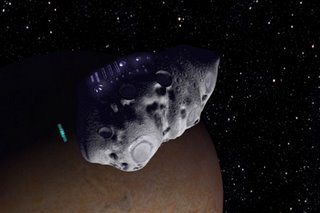
Travel To Mars Via Asteroid?

Since traveling to Mars can be dangerous to your health (thanks to cosmic radiation) some researchers are proposing that future astronauts travel to the red planet via asteroids that orbit between Earth and Mars.

(New Scientist Space) In one version of the idea, the astronauts would actually dig a hole in the asteroid, put the spacecraft inside and cover it over with material from the asteroid. Within this protective burrow, the spacecraft would be shielded from cosmic rays during the six- to 10- month journey to Mars.

In a second version, the spacecraft would not contact the space rock. Instead, it would hover nearby, and astronauts or robots would visit it on spacewalks. "You'd have the astronaut actually go to the asteroid and begin to extract material," Della-Giustina told New Scientist.


Hitch hiking via asteroids is pretty ingenious, although it may not work in the long term. If a martian colony is established and an emergency arises, we can not simply depend upon asteroids to bring us to safety across space.

What NASA needs to seriously consider is either investing in creating a radiation shield for the astronauts, or finding out faster ways to travel between worlds (via nuclear or momentum from a space elevator). Although radiation shielding is expensive, it would enable us to travel without fear of having our minds reduced to nothing upon arrival on Mars.

Hubble Trouble, Will Saving It Cost Double?

(Hat Tip: The Astronomy Blog)

Hubble has provided a unique perspective about the universe that no other space program has matched. Its beautiful pictures have probably kept the space program in public view, and helped launch the imaginations of thousands of others.

But keeping Hubble alive is costing NASA (or rather the American tax payer) $230-250 million a year, money that could be spent elsewhere (as in getting humans back on the moon). Despite the cost, NASA seems to have some emotional attachment to Hubble, although it may require two shuttles in order to secure approval for repairing our galactic eye in the sky.

(MSNBC) The remaining 14 shuttle flights are dedicated to completing the space station by the time the fleet is grounded in 2010. If a Hubble servicing mission is approved, it would have to be squeezed into the space station construction schedule sometime in early 2008.

NASA also would have another shuttle on the launch pad, ready to make an emergency rescue trip if there were a catastrophic problem.


The repair trip would only extend Hubble's life by about five years, which would mean that unless another shuttle or rocket was designed to replace it, there would be no easy way to repair Hubble unless the Russians were solicited.

Hubble has made the universe a lot more beautiful by revealing the hidden mysteries that surround us, but if it does not further humanity off world, what is the point in funding future repair missions?