Monday, September 25, 2006

Google Interviews Anousheh Ansari From Space

To my complete surprise one of Google's founders interviewed Anousheh Ansari from the international space station. Ansari is the first female space tourist and perhaps the prettiest as well. ;)

Here is a of what Larry Page's interview with the Iranian in space (questions are in bold for you convienence):

What was the most fun in space?
Flying from one end of the Space Station to the other. She's gotten so good that she can nearly make it all the way without hitting any walls.

What was the biggest surprise?
Seeing the Earth rotate for the first time. Every time Anousheh wants to remind herself that she's really in space, she looks out the window, watches the Earth rotating, and pinches herself to make sure she's still awake.

Larry (wistfully): When can we come up to join you?
You'll have to come up one at a time. In any case, construction is speeding up on the International Space Station, so tourists will probably be fewer for the time being. She hopes Larry can improve the food; although the cheese pasta is fun to chase, it's not much fun to eat. At least there are M&Ms.

What would you change about the space station?
(Fast reply): "Add another shower!" And then - "Add Internet access!" (Wild cheering from Googlers.) Right now email is batched. Larry suggested that Anousheh plan that for her next trip -- and she shot back, "Actually, I'm planning my next trip!"

Do you have anything inspirational to say?
"Explore the boundaries. Try new things. Be free-thinkers and use your imaginations. Learn from your environment, your teachers, your books -- but then go beyond your knowledge. I always wanted to go to space, although I didn't wind up working for NASA. I detoured to different areas, but finally I found a way to make it happen."


I have been reading Ansari's blog for quite some time and she seems to be really enjoying micro-gravity while floating around in the ISS.

Her latest post reveals how much respect their is between the astronauts and cosmonauts, and she compares the space station to Earth by saying we have no where else to go so we all better get a long on this planet.

I truly envy this Iranian, although she is planning on going again. I wonder if I'll get a chance to visit space, via a rocket shuttle or a space elevator?

Update: It looks like Ansari has inspired some Iranian women. Heh.

Friday, September 22, 2006

Habitat For Humanity...In Space

With all of the talk of "space tourism," very few businesses have a legitimate reason for visiting the stars other than viewing the Earth from space.

But what separates Robert Bigelow from the space tourism industry is that he desires not to merely take people on a short visit in space, but to build a space hotel for them to check into.

(Space.com) At a luncheon speech today in San Jose, Calif., at the AIAA Space 2006 Symposium, Bigelow said his third module, dubbed Sundancer, would have a mass of 8,618.4 kilograms and be equipped with life support systems, attitude control, three windows, on-orbit maneuverability, reboost and de-orbit capability.

He plans to place it at an altitude of 250 nautical miles at an orbital inclination of 40 degrees. Bigelow said that while Sundancer will be a scale model of the large, human-rated habitat he eventually plans to launch into orbit, it will nonetheless have 180 cubic meters of habitable space.


If Bigelow is able to get the space hotel up and operational, he will probably have to find an affordable way to bring those people into space (as $20 million plus may not be worth it to most people).

Although Lockheed Martin is partnering up with Bigelow Aerospace in order to provide a space ship to the hotel, they may want to consider the magnetic sled as a possible option as well (as it may be less expensive than sending a rocket into space).

Wednesday, September 20, 2006

New Hope For The Space Elevator?

(Hat Tip: The Space Elevator Reference and KurzweilAI.net)

Several months ago, some scientists determined that building the Space Elevator with current technology was impossible.

Now it appears that a couple of MIT scientists have discovered a way to not only allow engineers to create a mesh of carbon nanotubes but make them electrically conductive as well.

(MIT.edu) Now Young-Su Lee, an MIT graduate student in materials science and engineering, and Nicola Marzari, an associate professor in the same department, have identified a class of chemical molecules that preserve the metallic properties of carbon nanotubes and their near-perfect ability to conduct electricity with little resistance. [...]

Attaching a molecule to the sidewall of the tube serves a double purpose: It stops nanotubes from sticking so they can be processed and manipulated more easily, and it allows researchers to control and change the tubes' electronic properties.


MIT researchers have discovered that certain molecules can attach themselves to metallic carbon nanotubes without interfering with the nanotubes' exceptional ability to conduct electricity. At left, the high conductance state has two molecular orbitals, shown in green. Some molecules even let the nanotube switch between highly conductive, left, and poorly conductive (right, with one red molecular orbital), creating the potential for new applications.

_________________________________


MIT scientists seem to have discovered a way to make nanotubes "electrically conductive," which may be useful as a means of transferring power to the lifter robots. This new discovery could also be used to combine individual nanotube threads together, instead of the 100,000 km length molecules that some scientists image will have to be built.

Either way, this is good news for the Liftport team. Now how about building that Space Elevator already?

Could Going To Mars Damage Your Brain?

Cosmic radiation will be a significant problem en route to Mars, and unless resolved could put the whole "colonize the red planet campaign" out of action fairly quick.

(Space Travel) Among the gravest risks of a manned flight to Mars ranks the possibility that massive amounts of solar and cosmic radiation will decimate the brains of astronauts, leaving them in a vegetative state, if they survive at all.

Dubbed "Risk 29" by NASA's Mars scientists, the cosmic radiation risk remains a show-stopper because shielding a spacecraft from all radiation could make it too heavy to reach Mars, which, at its closest, is 38 million miles from earth.


Although scientists are working on experiments to determine how tolerant the human mind is to deadly radiation, working on radiation tolerance level may not convince the public to travel off world.

What scientists and engineers need to do is figure out a way to make a lighter shield around the space craft to insure that solar radiation does not hamper future colonists as there will probably be no chemotherapists around to treat cancer on that world.

They could also perhaps have construct a "detachable" shield around the craft, which they can discard once arriving on Mars.

If no radiation safe ways are developed for traveling to the red planet (among other worlds) then we can expect perhaps only a few thousand souls living on other worlds, instead of the hundreds of millions necessary to colonize our solar system.

Observing Mars Underground

The Mars Orbiter which recently established its presence around the red planet seems to be equipped with ground piercing radar that can detect ice (and hopefully water) on Mars a kilometer below the surface.

(Mars Today) The orbiter's Shallow Subsurface Radar, provided by the Italian Space Agency, will search to depths of about one kilometer (six-tenths of a mile) to find and map layers of ice, rock and, if present, liquid water. [...]

"We will use the Shallow Radar to map buried channels, to study the internal structure of ice caps and to see boundaries between layers of different materials," said Dr. Roberto Seu of the University of Rome La Sapienza, leader of the instrument's science team. "The data will provide our first detailed look just under the Martian surface, where ices might reside that would be accessible for future explorers."


Mapping where potential water ice is on Mars will be crucial if we are intent on surviving on that hostile world. If Mars holds an abundance of water beneath its surface, then we can build the necessary robots to bring it to the surface.

Although Mars may lack the necessary resources to make it attractive to businesses and governments, its greatest resource may be water which is worth more than gold in this solar system.

Update: Added image.

Why "The Moon Before Mars" Argument Makes Sense

Out of the Cradle points to an article published by the Planetary Society Blog which reviews arguments for both the "Moon first" and "Mars first" crowd.

Although colonizing Mars would be much faster if we directly visited the planet first, any major crisis developed on the world would spell an inevitable set back for the space program (and the colonization of our Solar System).

Mars is at its closest 38 million miles away from Earth, and if any crisis happens upon that world, a rescue mission will be a couple years away. This would spell doom for not only the future colonists, but result in the quest for space to be delayed another generation.

The Moon is a lot closer to the Earth, and although the surfaces of Mars and the Moon differ greatly, it would provide a "beta environment" for us to learn how to survive off world before our species decides to settle on other planets millions of miles away.

Although going to Mars may be critical for our species, going to the moon first makes more sense.

Friday, September 15, 2006

From Space Elevators To Solar Bridges?

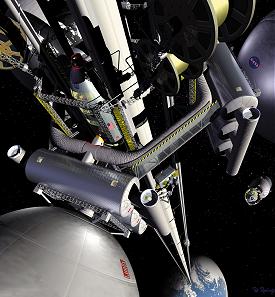
Imagine if you will that a small company out of Washington State (USA) achieves the impossible. Imagine if a company called LiftPort is able to successfully build a structure spanning from the oceanic surface to 100,000 km into space.

Such a feat would revolutionize the space industry entirely, and perhaps change the way we view space as we know it. But what if humanity went beyond constructing a planetary elevator into space, and decided to create a solar bridge connecting two worlds?

Solar bridges, like space elevators, would revolutionize the way citizens on two worlds engage in trade and transportation. Instead of having to launch shuttles into space (which can become fairly tedious and expensive), residents could simply transport their goods through an inter-planetary auto-bahn without worrying about the size and the amount.

A solar bridge would also serve as a "rest stop" for future star ships needing to deploy goods between worlds. Instead of docking on a space station and requiring its resources/crew to descend upon the world via miniature rocket shuttles, a solar bridge would enable star ships to quickly deliver necessary goods by tapping into the "economic blood stream" of the planetary system.

Last but not least, a solar bridge would enable scientists, governments and businesses to conduct research within a microgravity environment without having to board a shuttle. This would not only reduce the cost of these studies, but enable them to transport the fruits of their labor back home or towards the other side.

But just like their space elevator ancestors, solar bridges would only be feasible under certain conditions, and most planetary systems would probably not be suitable to host one.

They would have to be constructed in a region free from hazardous space debris (such as asteroids, comets and space junk). They would also have to be located within a binary system whose worlds are gravitationally locked, otherwise the rotation or orbit of one of these worlds would simply tear the structure in half.

Although the only planetary system meeting these conditions is Pluto and Charon, humanity may want to consider drawing plans for such a feat, especially if they encounter binary systems in other solar systems.

Humanity is a community orientated species, and one can notice this by observing the massive bridges built between cities, and even countries. If the conditions are favorable enough, why not attempt to build something similar between two worlds?