Sunday, July 23, 2006

Drilling For Water On Mars

Before we can actually establish a colony on the red planet, we first need to locate adequate supplies of water. If scientists are able to locate where possible sources of water lie on Mars (via new technology, rovers or telescopes) then it will be much easier to set up a colony on that dusty world.

But before humans are sent towards Mars, robots will have to do the dirty work first. And it looks like scientists are building one smart enough to handle the job.

(Red Orbit) NASA scientists plan to drill someday into the surface of Mars to look for water and signs of possible life. So, scientists are developing an automated, unmanned drill rig that can operate totally on its own, unsupervised for hours at a time. [...]

An eight-person team, made up of scientists and engineers from NASA Ames Research Center, Moffett Field, Calif., will set up drilling equipment that is a little taller than a human being, and sits in a footprint of about one square yard (one square meter).

Earth-based experiments will help scientists learn if synthetic brainpower is able to control a rig on Mars for many hours of drilling without human intervention. Future Mars missions with drills will likely have the ability to communicate with Earth only once or twice a day.


Since people will be unable to directly observe what is happening on Mars, scientists were forced to create an AI (or artificial intelligence) for the bot. Using lasers, vibration sensors and logic, this machine will be able to tell when to stop drilling, adjust and (hopefully) locate any problems that come along the way.

Called the Drilling Automation for Mars Exploration project (or DAME for short), this piece of technology will become very useful once we begin the first stages of colonizing Mars.

Exploring Mars Via Minibot Balls?

Mars is a harsh world and sending rovers to understand is not only expensive, but fairly limiting. But engineers and scientists may have found a new way to explore the red planet by using mini bot balls to scour the Martian surface.

(Universe Today) MIT engineers and scientist colleagues have a new vision for the future of Mars exploration: a swarm of probes, each the size of a baseball, spreading out across the planet in every direction.

Thousands of probes, powered by fuel cells, could cover a vast area now beyond the reach of today's rovers, including exploring remote and rocky terrain that large rovers cannot navigate. [...]

Scientists believe that lava tubes commonly seen on Mars are a promising location to search for signs of water. Lava tubes are tunnels left behind by underground lava flows. Signs of these tubes, which are also present in many locations on Earth, can be seen above ground.


Although observing the red planet through rovers is fine, what scientists need to do is locate water on the Martian surface. Despite being the focus of NASA and other space agencies for years, Mars desperately lacks resources for the human race.

These balls may be able to locate resources in hidden locations, since they are more expendable than a multi-million dollar rover.

Thursday, July 20, 2006

International Lunar Decade Begins In 2007?

The Planetary society is attempting to keep the vision of lunar exploration alive by calling for an international lunar decade set to begin next year in 2007.

(Moon Today) The Moon is "hot." China, India, Japan, Italy and the United States are all currently planning lunar missions, and the European Space Agency has the SMART-1 spacecraft in orbit there right now.

"The Moon is the first step beyond low Earth orbit for any space-faring nation," stated Louis Friedman, Executive Director of The Planetary Society, "and the next decade will see a number of nations taking that step."


With all that is going around in the world (ranging from bird flu to world war three via Iran) keeping the world community focused on lunar exploration is not only key, but a priority. Although the decade technically extends to 2019, (making it twelve years) it coincides with the presumed future landing on the moon.

Europe Building Its Own "Hubble" Telescope

It looks as if our European friends have decided to build their own version of NASA's Hubble.

(Red Orbit) We believe that the European Extremely Large Telescope is essential if we are to ensure the continued competitiveness of the astronomical community in ESO's member-states, said Catherine Cesarsky, ESO's director general.

The ESO said a baseline design is to be presented by the end of this year for a telescope with a primary mirror between about 100 feet to 200 feet in diameter and estimated to cost approximately $944 million.


I wish all the luck to them in this endeavor. Of coarse, nothing thus far has been able to compete with Hubble, although it would be good if another country was able to inspire some friendly competition. After all, it's getting to be very lonely being the only space power on planet Earth.

Tuesday, July 11, 2006

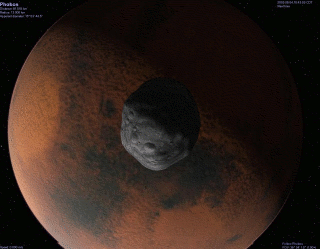
Martian Moons As Future Space Stations?

Update: Incorporated sources within post and edited text for clarity.

(Note: Published on Blog Critics)

Mars is a world that has captivated the minds of humanity for thousands of years. While it is not known whether or not this world harbors any resources, this rusty world, after the Moon, will probably become humanities first test on whether or not we can survive off world.

But before humanity can conquer the red planet, they need a cost effective way to transport food, passengers and supplies towards its surface. Hosting as well as launching large shuttles on the planets surface may become burdensome and expensive, especially when one considers the effect of red dust upon mechanical devices.

What Martian colonists need is an inexpensive way to transport goods from the surface to space, and what better way could they obtain this than by turning the Martian moons into space stations?

The Martian moons Phobos and Deimos orbit about 6,000 and 14,500 miles from the surface, respectively, and would lie within easy reach for smaller space craft (especially with Martian gravity being only 38 percent of Earth's).

Although launch pads hosting large rockets may look appealing on Earth, they would probably be considered a waste on the red planet. Launch pads hosting large rockets would not only have to be constantly cleaned of the red dust, but be enclosed within a powerful warehouse capable of surviving Martian tornadoes. It would be much easier to host smaller shuttle craft that could "ron de vue" with a larger ship via a space station than launching these massive vessels from the surface.

Despite being composed of carbonaceous rock, the orbital periods of the moons make them prime real estate. Phobos orbits Mars about every 7 1/2 hours while Deimos is just over 30, making them accessible (at least with Phobos) several times a day. If constructed properly, larger ships could simply dock near or inside the asteroids and simply await smaller shuttles to transport the necessary goods or passengers to and from the planet.

Also the lunar asteroids close proximity towards their parent world would give them a bird's eye view of any storms that may potentially delay a launch or prevent a landing on the crimson planet.

Last but not least, by altering the barren asteroids into technological habitats, it would provide a way for Mars to process any metals or minerals harvested from the asteroid belt before being transported to the surface below. This would probably not only reduce costs but also enable them to manufacture stronger materials as well (since it is being done in micro gravity).

After the moon, colonizing Mars will be humanities first taste of conquering another world. But unlike the Moon, future Martian colonists will be unable to depend upon resources in great demand in order to finance their stay on the red planet. Keeping costs down while thriving on Mars will be in the best interests of humanity, and transforming both Phobos as well as Deimos into space stations may aid in that regard.

New Way To Locate Earth-like Worlds

One of the reasons it is hard for us to spot Earth-like worlds is because of the brightness of their parent star. A new technique with current technology may find a way of eliminating that brightness and allow us glimpse worlds beyond our solar system.

(MSNBC) A thin plastic "starshade" shaped like a giant daisy flower could one day help astronomers observe faraway planets by blocking out unwanted light from their parent stars, a new study reports.

When telescopes point to a distant planet, the small amount of light reflected by the planet is overshadowed by the light from its parent star, making it especially difficult to be seen. [...]

One way to tackle this problem is to place a shield, known to Sun-watchers as a coronagraph, inside the telescope. In this way, astronomers block out the main light from our own favorite star, providing a view of the environment around it.


If we are able to locate star systems harboring worlds that are favorable, not only would this encourage humanity to explore the stars, but we would have an idea of which direction to head towards in the first place.

Saturday, July 08, 2006

A New Direction

I've decided to take this weblog into a more "focused" approach. Instead of covering everything revolving around space (as there are already sites doing that) instead I'll focus on what I love--discussing about which worlds are worth colonizing for the human race and which ones are not.

I'll probably resume posting tomorrow, so stay tuned.