Friday, February 10, 2006

Asteroid Mining Part Of Space Economy

Although seen by many as hazardous rocks orbiting our star system, asteroids may be more profitable than most people think.
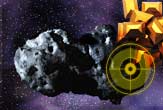
(Space.com) Spectroscopic studies suggest, and 'ground-truth' chemical assays of meteorites confirm, that a wide range of resources are present in asteroids and comets, including nickel-iron metal, silicate minerals, semiconductor and platinum group metals, water, bituminous hydrocarbons, and trapped or frozen gases including carbon dioxide and ammonia.

As one startling pointer to the unexpected riches in asteroids, many stony and stony-iron meteorites contain Platinum Group Metals at grades of up to 100 ppm (or 100 grams per ton).

Operating open pit platinum and gold mines in South Africa and elsewhere mine ores of grade 5 to 10 ppm, so grades of 10 to 20 times higher would be regarded as spectacular if available in quantity, on Earth.


Although the general population of the human race will reside on terrestrial worlds (such as the Moon, Mars, Europe, etc.), many colonists may find themselves employed by mining operations harvesting these solar rocks.

Mining asteroids may not only be more practical, but it may also prove to be more economical as well.
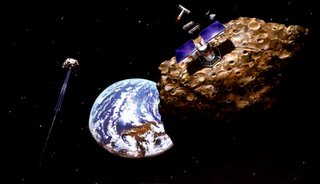
(Space.com) Since the competing source of raw materials is "delivery by launch from Earth," which imposes a launch cost per kilogram presently above $10,000 per kg, this same figure represents the upper bound of what recovered asteroidal material would be presently worth in low earth orbit.

Future large scale economic activity in orbit is unlikely to develop however until launch cost drops to something in the range $500 to $1,000 per kilogram to LEO. [...]

Note that the asteroidal materials we are talking about are, simply, water, nickel-iron metal, hydrocarbons, and silicate rock. Purified, and made available in low earth orbit, they will be worth something like $500,000 per ton, by virtue of having avoided terrestrial gravity's "launch cost levy."


Initially launching operations to harvest the space boulders will be costly, and of course the rubble gathered from the mining operations will have to be filtered "for goodies."

However, in the long term, seizing upon this initiative will enable humanity to obtain a wealth of mineral resources. This will aid in building future colony bases, star ships, as well as space stations inexpensively, allowing a future space economy to develop and flourish.

NASA Turning Water Into Oxygen

A device built by NASA for the International Space Station could allow for future colonists on other worlds to develop breathable oxygen from water.

(Red Orbit) NASA is preparing to launch an oxygen generation system to the International Space Station. The system uses water to generate breathable oxygen for crew members. Life support systems like this are necessary to support future long-duration missions to the moon, Mars and beyond. [...]

The system will also help replace oxygen lost during experiments and airlock depressurization. Once activated, the oxygen generation system may daily provide up to 20 pounds of oxygen.


The device needs little monitoring and during normal operating periods develops up to 12 pounds of oxygen daily. This is enough breathable oxygen for six people, which is good news for future space travelers everywhere.

(Red Orbit) "Advancing life-support technology will become increasingly important as we pursue missions to the moon and Mars," said Bob Bagdigian, project manager at Marshall's Center for the Regenerative Environmental Control and Life Support System.

The oxygen generation system is one of two primary components in the station's regenerative environmental control and life support system. The other component, the water recovery system, is planned for shipment to Kennedy early next year, once testing and design modifications are completed.


The water purification system basically recycles wastewater (i.e. urine, etc.) which will help reduce costs. This could potentially be coupled with the Oxygen device, as its primary function is separating the hydrogen from the two oxygen molecules.

As more devices like these are developed, sending humans to other worlds will become less burdensome.

Tuesday, February 07, 2006

Intelligent Design, Fact Or Fiction?

(Via Answers In Genesis, Published on Blogger News)

Update: Removed photo.

While the debate over God (and what he consists of) rages throughout America and in a few locations throughout Europe, a "new philosophy" seems to be attracting the attention of clergy and scientists alike.

Intelligent Design, (also known as ID) is championed as an alternative towards evolution and a legitimate theory of the origins of our species.

But despite the press about this theory from the right and the left, this belief system lacks a critical element key for any scientific faith which can be boiled down in one word--clarity.

Evolution and Creationism are classified as theories because both have a clearly laid out thesis stating the origins of the human race. This allows outsiders, believers and the curious to test out both of these theories to see if any of them hold up under serious examination.

Despite what proponents might say, Intelligent Design lacks a clear thesis stating humanities origins, which leaves the origins of man open ended. This formulates "a big tent" philosophy club where theists and atheists can come together respectively, despite the contrast of ideals.

One can examine whether or not Noah's flood happened as well as if there is any evidence to support the fossil record (despite its many gaps). Even the Raelian Society (viewed by many as "a fringe group") has a testable thesis, something the ID movement lacks.

Although fought in courts and class rooms throughout America, Intelligent Design seems to be lacking in the substance arena. Unless this is provided, ID will be nothing more than a philosophy that satisfies the phlegmatic agnostic rather than stimulating us all towards scientific enlightenment and discovery.

Where Is The Best Spot For A Lunar Colony?

Scientists seem to be engaged in a debate as to where should humanity first set up a lunar colony. While some argue in favor of the polar regions, others look at the darker Maria instead.

(New Scientist Space) ...[A]t least one landing site should be located on dark volcanic rock deposits--called pyroclastic deposits--mainly found away from the Moon's poles.

The deposits are thought to run deep and contain extremely fine-grained particles likely to be rich in material that could be used for in situ manufacturing. Besides raw materials, McKay says, the overall advantage is that "producing oxygen and hydrogen from lunar pyroclastics may be significantly simpler and cheaper than from any other lunar feedstock."


Resources are an important factor when colonizing any world, something Mars seems to be lacking when compared to the Moon. The debate basically boils down towards necessities. While the McKay argues towards the lunar Maria, others provide reasoning for the polar regions.

(New Scientist Space) "Half of the science community says the most interesting place to go is the polar regions and half of the community says it's the equatorial regions," [Butler Hine, deputy program manager for the Robotic Lunar Exploration Program at Ames Research Center in California, US.] says. "But my prediction is that the first lander will go to the polar regions." he told New Scientist.


Heading towards the poles would probably be a wiser maneuver, even if it is easier to mine oxygen from the general plains. Doing so would enable colonists to take advantage of the suns rays as the poles are a perfect spot to build solar panels on.

But hopefully these scientists will be able to arrive at a conclusion as to where we should start building a lunar base. Because if we do not move beyond the debate because of slight preferences, Russia may beat America towards the surface.

Friday, February 03, 2006

Google Expanding Towards The Stars

The search giant Google has been granted more time by NASA in order to come up with ideas for research in their latest round of talks.

(Red Orbit) With new ideas still sprouting, NASA agreed Wednesday to give Google more time to submit a detailed plan to build a large research park and collaborate with NASA scientists at Moffett Field. Wednesday's deadline for laying out plans was extended until May 31.

"Everyone got so excited with all of the possibilities for collaboration, we decided we needed more time to put this plan together," said Michael Marlaire, NASA's director of external affairs and development.


Google (as usual) refused to comment what those ideas could be, but it seems like the partnership between the world's largest search company and the world's finest space program could have a positive influence for humanity. Especially in the realm of education.

(Red Orbit) But a memorandum of understanding signed by NASA and Google last November laid out four general areas in which the company might collaborate with space agency scientists: large-scale data management; connecting smaller computers for supercomputing; converging nanotech and biotechnology; and helping launch private commercial space travel. [...]

Besides extending the deadline, the two sides agreed Wednesday to add a new component to the collaboration: involving Google in the many education programs held at Moffett Field. Those programs bring thousands of schoolchildren and college students to Moffett campus near Mountain View every year to learn about astronomy and other scientific missions.


Google currently has several products to help people explore their world to a greater degree. Google Earth allows users to surf the world around them at different altitudes, and at different angles.

Google currently does not offer any programs to surf the galaxy, although if one is interested in doing so the Celestia Motherload may be what they are looking for.

Are Humans And Chimps Really Cousins?

(Update: Article corrections made on February 6th, 2:32 pm).

Despite what may be taught in the classrooms of America, our associations with "our cousin" may not be as close as many people think. Scientists have for many years declared humanities close ties with the chimp, boasting the similarities between our genes.

Dr. Georgia Purdom, a molecular geneticist takes a closer examination and publishes her observations.

  • The chimp genome is 12% larger than the human genome.

  • Only 2.4 billion bases have been aligned between the two genomes, leaving a maximum similarity of 68-77%.

  • In many areas of the genome, it appears major rearrangements of DNA sequences have occurred, accounting for another 10-20% dissimilarity.

  • Chimps have 46 chromosomes and humans have 44 chromosomes (excluding sex chromosomes for both species).

  • To save money and time, the chimp genome was assembled using the human genome as a template (because of the presupposition that humans evolved from the same line as chimps); it is currently unknown if the pieces of the chimp genome "puzzle" were put together properly.


This comes to no surprise to this author, who at one time submitted his views towards the theory of evolution. Despite the thousands of books that have been written about this theory, it yet to provide an explanation refuting the serious holes in Darwins faith (such as the gap in the fossil record and why only one star system is similar to ours out of 150 worlds discovered).

The debate over who founded the universe will probably be discussed and debated fiercely well into the next century. As Purdom notes, all scientists have their specific biases before entering the lab, and generally look for clues or evidence backing up their theories.

Evolutionists do not understand why Creationists pray to a being they reject as existing, while Creationists are surprised that Evolutionists refuse to bring the debate into the classroom.

Although this author does no longer adheres to Darwin's faith, discussion of our origins between the two philosophies is important, and will hopefully lead towards a final conclusion to our beginnings.

Can Humanity Colonize Binary Systems?

Despite recent observations of the universe have revealed that most stars are single, humanity may have to prepare to colonize worlds with multiple star systems.

(Planet Quest) Principal investigator Deepak Raghavan, a doctoral student at Georgia State University, sifted data on 131 extrasolar planetary systems over a two-year period and confirmed that 26 of those systems were binary, or two-star systems. Three others were found to be trinary, or triple-star systems.


Although our species has not had the chance to colonize distant star systems, we may have to prepare for the possibility of colonizing worlds a bit more hostile than our own. But hopefully we can find worlds that are more suitable, even if they orbit a binary system.