Friday, September 29, 2006

Video: Space Elevator Tether Concept

After surfing Google Video, I came across this video explaining the space elevator in "every day language" which is quite useful when explaining something they have only heard in story books (say Jack in the giant beanstalk).


This video displays a pretty good explanation of what the Space Elevator is all about, and may be quite useful, especially when presenting this video to a group of people as a LiftPort Ambassador (although I will probably need to secure approval from LiftPort first as it is their presentation).

Are Titan's Methane Lakes Evaporating?

It is probably a good thing Titan does not have a stock market, otherwise its fuel prices would be jumping through the roof at this news.

(New Scientist Space) A dozen more lakes have been discovered near the north pole of Saturn's moon Titan, according to images from the Cassini spacecraft's latest flyby of the moon. The lakes may be a seasonal phenomenon, filling with methane rain in the winter, then evaporating in the summer. [...]

The lakes may accumulate near the north and south pole in alternating periods when each experiences its winter and lower temperatures lead to more methane rain, [Stephen Wall of NASA's Jet Propulsion Laboratory in Pasadena, California, US.] says.


The key words in these paragraphs is "may," as the scientists seem to be unsure. Hopefully in the not so distant future (say 50 years) we will be able to land either a rover on Titan's surface or send humans to the moon before these lakes evaporate completely.

Tuesday, September 26, 2006

Micro Gravity Surgery Becoming A Reality?


With all of our eagerness to conquer the final frontier, we often over look a minor yet critical job that will be needed while en route to Mars, Jupiter or beyond the Sun's influence--space surgeons.

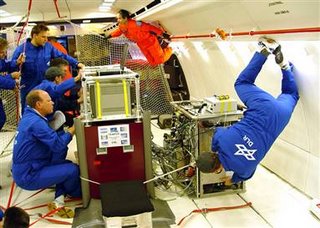
A team from France will be removing a cyst from a man via robots, the first ever attempted feat while in micro gravity.

(MSNBC) The operation, announced Monday by chief surgeon Dominique Martin and the French space agency, is part of a project backed by the European Space Agency that aims to develop earth-guided surgical space robots. [...]

Albertoni said the cyst removal operation was chosen because it is relatively simple and involves a local anesthetic.

The doctors say their experience Wednesday could help in the development of robots to perform surgeries in space.


Thanks to the Airbus A300 (which can simulate micro gravity by climbing and falling throughout the atmosphere), doctors will be able to perform the operation and take notes for the medical community.

Operating on someone while in space will not be an easy feat, mainly because blood and other liquids would have an easier time floating out of the body, not to mention sharp floating objects (i.e. scalpels). Although the latter can be restrained via magnets, the former may be a bit harder to stop in space.

Using space robots to operate may be a wise decision as there may not be too many doctors interested in working off world.

Space Elevator Goes Wireless

(Hat Tip: The Space Elevator Blog)

Who says you can't use a mini-space elevator to generate some cash?

It appears that the boys and girls (are there any girls?) at LiftPort are using their robotic climbers to help setup wireless platforms for rural areas.

(New Scientist Space) [...] LiftPort has finished a 60-day test with a 100-metre-long tether held aloft by four helium balloons. The test was designed to see what kinds of problems would crop up if such a platform were used to transmit Wi-Fi signals. The lofty platforms would be especially useful for providing Wi-Fi coverage to rural areas, says company president Michael Laine.


While doing the test, LiftPort did run into some humorous problems with wild life involving bats, insect colonies breeding on the tether and swallows trying to sip morning dew off of the balloons. They also discovered that the wind can twist the tether, causing it to thicken which results in broken climbers (a problem they will have to resolve before building the space elevator).

But despite the setbacks of the test, it appears as if LiftPort has taken another step towards building an actual space elevator.

(New Scientist Space) Several weeks ago, the company also made its own carbon nanotubes for the first time. Because carbon nanotubes are extremely thin but incredibly strong, they have been studied for use in a lightweight tether that could reach all the way to space.


A space elevator, if successfully built will increase the likely hood that humanity will travel to the stars, especially since public support for space may be declining.

Monday, September 25, 2006

India To Reach The Moon In 2008?

It appears that India has settled the debate on whether to send robots or humans into space. Unfortunately they have decided to go with the robots (as this author was rooting for the humans).

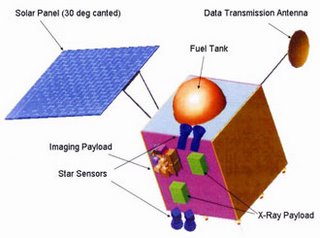
India will be planning a lunar mission around 2008, and will launch a satellite to locate not only valuable resources but water as well.

(Moon Daily) Discussing the aforesaid programme of ISRO, chairman PRI council, ISRO-DOS, Prof UR Rao said: "The mission aims to search for surface or sub-surface water-ice on the moon, specially at the lunar pole and to carry out high resolution mapping of topographic features in 3D. It would also look into the mineral composition of the moon." Rao, who is also Chancellor of Ambedkar University, was in the city on Tuesday.

Though Mission Moon would commence from 2006 and would culminate on 2008, space agencies of US (NASA), European Space Agency, Japanese and Chinese space agencies are working together to unravel some lesser known facts about the moon.


Getting India involved with space exploration is critical since one in six people on Earth reside in that nation of a billion faces. Although they are not sending any people to the lunar surface, their research should prove invaluable as it will help us locate the best spots for a lunar colony (and hopefully end the debate of where to establish one first).

Is Pluto's Atmosphere Freezing Too Fast?

It looks as if the previously thought out theory of how Pluto's atmosphere freezes has been shattered with new observation of the dwarf world orbiting billions of miles away from our Sun.

(Pluto Today) Pluto's surface is bright because its atmosphere periodically condenses onto the surface. Theory suggested that, as Pluto cools, the traces of methane should condense first, followed by nitrogen ice as Pluto's surface grows colder.

The study showed two surprising results: that most of Pluto's nitrogen ice contains dissolved methane and that the area covered by pure methane ice patches is roughly the same as the areas covered by the nitrogen methane mixture. The fact that methane ice is mixed in with the nitrogen suggests that the freeze-out process happens quickly and haphazardly.


Despite the controversy surrounding Pluto's demotion, this world (or rather dwarf world) still fascinates scientists with its patchy surface of nitrogen and methane.

Although orbiting over six billion kilometers away from the Sun, Pluto may hold some value for future explorers as methane is a valuable resource, especially in deep space.

China's Seed Breeding Satellite Returns

It looks as if the satellite China previously launched into outer space has returned bearing "fresh fruit,"--scientifically that is.

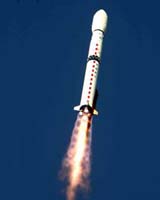
(Space Daily) China's seed-breeding satellite, Shijian-8, successfully landed in Sichuan Province, southwest China, at 10:43 a.m. Beijing time on Sunday after a 15-day flight in space. The recoverable satellite was launched from the Jiuquan Satellite Launch Center in the northwest China desert on Sept. 9. [...]

Scientists from the Space-breeding Center of the Chinese Academy of Agricultural Science used the mission to carry out experiments aimed at discovering what happens to the germination and sprouting of plants when they are exposed to zero gravity.

After being exposed to cosmic radiation and zero gravity, some seeds may mutate and produce higher yields and improved quality when planted back on earth, scientists said.


It is interesting that the Chinese are exploring "space agriculture" and using the gained knowledge to benefit their farms on planet Earth. Although China's interest may sound silly to some, this technique of altering grain in space may become critical for future colonies of Mars and Jupiter since they lack the nutrient rich top soil common on Earth.

Of the three main space powers sending human beings into space, China seems to be the most aggressive at using space to benefit its people directly. Although NASA has the skills to get us to the stars, China has the will to get us there, and the future alliance between the two may benefit the human race for years to come.