Tuesday, May 09, 2006

Checking In At The Inflatable Space Hotel

Imagine relaxing in your pajamas, sipping on solar wine while reading the latest news from the Lunar Times--all from the comfort of your micro-gravity bed. The only catch is that the station your staying in has no hard floors, no direction of "up," and no cutting lasers are allowed on board.

Ladies and gentlemen, welcome to the Inflatable Space Hotel.

(Times Online) AN inflatable hotel that will orbit the Earth is being built by a millionaire hoping to kickstart interest in space tourism.

Robert Bigelow, an American hotelier who says he wants to open up space to the general public, is ploughing more than £280m into the project.

The blow-up structure will be launched on rockets and self-inflate to its full size once it is circling the globe.

Its 1ft-thick skin, made from a toughened combination of multi-layered polymer and Kevlar, will allow it to expand while keeping the astronauts protected from space meteorites.


Believe it or not, this project was originally started by NASA, but due to financial constraints they were forced to abandon it in its infancy. Bigelow decided to buy it out in an attempt to not only make money, but also attract Hollywood and drug companies into space.

(Times Online) In addition to being used as a hotel, the structure may be leased to astronauts and pharmaceutical companies wanting to use it as a medical testing centre.

Bigelow hopes the hotel, which would open some time after 2015, will also be in demand as a shooting location for film-makers.


If successful, a future space hotel could revolutionize the space construction industry. Such a project would require fewer launches, allowing NASA to concentrate its efforts on building ships and lunar craft, not to mention working on colonizing Mars.

Bigelow plans on launching a beta type first, which will test the amount of radiation received through "the vessel" (and other dangers) before populating it with humans.

Monday, May 08, 2006

Mexico Headed Into Space

It looks as if our Hispanic brethren are going to consider heading towards the stars along with their American neighbors and the Canadians from the great white north.

(MSNBC) They may be light years away from fulfilling their dream, but Mexican lawmakers are preparing to launch a national space agency they hope could one day stand tall beside the United States' NASA. [...]

With an initial budget proposal of less than $2 million, the backers of the Mexican Space Agency say it would struggle to challenge its northern neighbor's National Aeronautics and Space Administration, or NASA, but hope it would draw Mexico into the international space community, bringing access to cutting-edge technology and research.


Mexican lawmakers still need to pass the bill in order to create this agency, but its addition would not only aid the nation technologically but also economically as well (after all, launching satellites should be cheaper down there).

Saturday, May 06, 2006

Saturn's Titan A Desert World, Lacks Methane Oceans

It appears as if the world once herald as harboring oceans of methane is nothing more than a dust bowl consisting of sand. Although nearly a billion miles away from planet Earth, this is a major blow to the future Saturn economy and a temporary setback for humanity.

(Universe Today) Radar images taken when the Cassini spacecraft flew by Titan last October show dunes 330 feet (100 meters) high that run parallel to each other for hundreds of miles at Titan's equator. One dune field runs more than 930 miles (1500 km) long, said Ralph Lorenz of UA's Lunar and Planetary Laboratory.

"It's bizarre," Lorenz said. "These images from a moon of Saturn look just like radar images of Namibia or Arabia. Titan's atmosphere is thicker than Earth's, its gravity is lower, its sand is certainly different -- everything is different except for the physical process that forms the dunes and resulting landscape."


Scientists are unsure of what the grains of sand (resembling coffee grounds) exactly consist of. Titan's sand could consist of organic compounds, water ice, or even a mixture of both. There was hope that potential rain may provide a resource for methane oceans, but further analysis reveals that rain is just as common on the world as the Sahara desert.

(Universe Today) Observations and models of Titan show that clouds and rain are rare. That means that individual storms could be large and still yield a low average rainfall, Lorenz explained.

When the UA-led Descent Imager/Spectral Radiometer (DISR) team produced images taken during the Huygens probe landing on Titan in January 2005, the world saw gullies, streambeds and canyons in the landscape. These same features on Titan have been seen with radar.

These features show that when it does rain on Titan, it rains in very energetic events, just as it does in the Arizona desert, Lorenz said.


If Titan did posses oceans of methane, then it would have been able to fund future projects to colonize Uranus, Neptune Pluto and beyond. It seems as if this economic jumpstart may no longer be available for humanity to exploit, so unless a new resource comes along, there will be little motivation to colonize any worlds beyond Saturn.

Mars Before The Moon?

It seems that a scientist is advocating that humanity by pass the moon in order to visit Mars.

(Red Orbit) Robert Zubrin uses his vision of the past to extol his vision for the future, but he never allows himself to go off on a tangent. [...]

"Mars is like North America, the moon is like Greenland," Zubrin said. "Greenland is closer to Europe, easier to reach, but it was not really a place where you could establish a branch of new human civilization. That's why we need to make Mars our goal."

It's why there's a Mars Society, because the planet "resolves the question of existence of life in the universe," he said, "and because of the future of humanity. Mars still has the resources to support life in ways the moon ... doesn't have."


Although Mars is a very unique world, it unfortunately will not pay the bills (unlike our lunar neighbor). Traveling to Mars first would be financial suicide as there are no known major resources on the planet or hints of any being discovered. It would mean trillions of dollars of debt for perhaps millions in profit.

The Lunar idea seems not only more profitable, but logical as well (Hint: it is much closer).

Update: Added source link.

Wednesday, May 03, 2006

Colonizing Mercury, Could It Be Done?

(Published on Blog Critics)

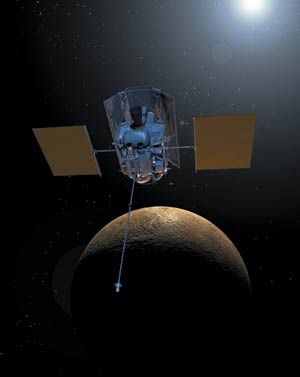
Mercury is a world unlike any other. Reaching temperatures up to 427 degrees Celsius, Mercury is not the place one would choose to go sun tanning.

Mercury is a very barren and harsh planet, with little economic value, unlike the Moon. But what if technology revealed precious metals beneath its surface, enough to convince humanity to face the dangers of space, and reap its potential resources for our benefit. Would we be able to colonize the first rock from the Sun? Could it be done?

Because of its closeness towards the Sun, Mercury lacks the "explorer appeal" that surround both Mars and Earth's lunar neighbor. However, Mercury does have several advantages over both the Moon and the red planet, which might make it appealing towards future colonists heading for the stars.

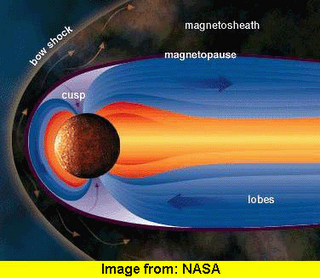
Mercury is one of the few terrestrial worlds boasting a magnetic field, along with Earth and Jupiter's moon Ganymede. This field is critical as it helps filter out harmful rays from the sun, which can be devastating towards the human body.

Although only at about 1% strength when compared to Earth's, Mercury's magnetic field deflects the solar wind about a thousand kilometers from the surface. Despite its size, this small region of covering may be more than enough to protect human explorers.

Another advantage point is that Mercury's gravity is about 38% when compared to Earth's. Although this may not seem like a major issue, gravity plays an important part in our lives and micro-gravity can be devastating towards the bones and muscles of the human body. Since some scientists consider gravity over one third (or 33%) to be acceptable for the human body, Mercury would be one of the few terrestrial worlds habitable long term.

Although being close to the Sun has its disadvantages, it does carry with it one advantage--solar energy. Since a day on Mercury is approximately 58 and a half Earth days, the planet could benefit from long periods of uninterrupted sunlight. Solar panels could be constructed around the world, with future communities "borrowing power" from sunlit regions or switching to nuclear power during the weeks of darkness.

It's closeness towards the sun would also provide scientists with a way to observe solar phenomenon more closely, allow us to understand space whether and perhaps establish an early solar storm warning throughout the star system.

Aside from basic planetary data, very little is known about this world. As NASA and other organizations set their sites upon the Moon and Mars, they may want to consider adding Mercury to the list, as its density (second only to Earth's) may hint at the possibility of mineral and metallic resources.

Whether through commercial, scientific or possibly penal interests (as a future prison world), colonizing Mercury may not sound as far fetched as some imagine and we may one day in the future call this world our home.

Sources: Solar Views-Mercury, Space Physics Center, Science Frontiers, Enchanted Learning.com, NSBRI, Permanent.com

Thursday, April 27, 2006

Uncle Sam Regulating Space Citizens?

It seems that the American government has decided to keep track of US citizens and corporations that engage in space flight. In order for one to fly, they would need to apply for a space permit.

(Flight Global) Washington claims right to regulate suborbital launches made by US companies anywhere around the world

US persons or organisations operating suborbital test flights outside the USA will still have to obtain a Federal Aviation Administration permit, according to newly proposed rules.

This is because, under existing international treaties, governments are responsible for launches made by their citizens or legal entities beyond their own borders.


The Federal Aviation Administration (FAA) is hoping that these new rules become permanent regulations by the end of this year. Some may see this as minor bureaucracy, but a more reasonable explanation (outside of security) would suffice--taxes.

Sunday, April 16, 2006

Mars Trip Safer With Antimatter Ships?

If humanity is to conquer the red planet, they need to be able to cross the gulf of space as quickly as possible. Otherwise future colonists may suffer from health problems such as bone loss and muscle fatigue when en route towards Mars.

However, if a future antimatter engine can be built, then those future threats could be eliminated, if not at least reduced.

(Red Orbit) Antimatter is sometimes called the mirror image of normal matter because while it looks just like ordinary matter, some properties are reversed. For example, normal electrons, the familiar particles that carry electric current in everything from cell phones to plasma TVs, have a negative electric charge. Anti-electrons have a positive charge, so scientists dubbed them "positrons".

When antimatter meets matter, both annihilate in a flash of energy. This complete conversion to energy is what makes antimatter so powerful. Even the nuclear reactions that power atomic bombs come in a distant second, with only about three percent of their mass converted to energy.


Unlike the nuclear powered space craft, a "positron" powered ship would be safer and more efficient. Many scientists have opted towards a nuclear powered craft in order to reduce time while in flight. However, reactors can be complex and a slight error could spell doom for all on board--especially during a launch.

(Red Orbit) If a rocket carrying a nuclear reactor explodes, it could release radioactive particles into the atmosphere. "Our positron spacecraft would release a flash of gamma-rays if it exploded, but the gamma rays would be gone in an instant. There would be no radioactive particles to drift on the wind. The flash would also be confined to a relatively small area.

The danger zone would be about a kilometer (about a half-mile) around the spacecraft. An ordinary large chemically-powered rocket has a danger zone of about the same size, due to the big fireball that would result from its explosion," said Smith.


Currently the price for assembling 10 milligrams of anti-matter is around $250 million. This price could be reduced through research as well as technology, and is probably less expensive than chemical rockets which cost around $10,000 per pound.

This would probably be easier to develop than a safe nuclear reactor and may be a preferable choice amongst astronauts--since no one probably enjoys riding with a nuclear device strapped to their back.